NASA MAVEN Mission Reveals How Martian Auroras Form
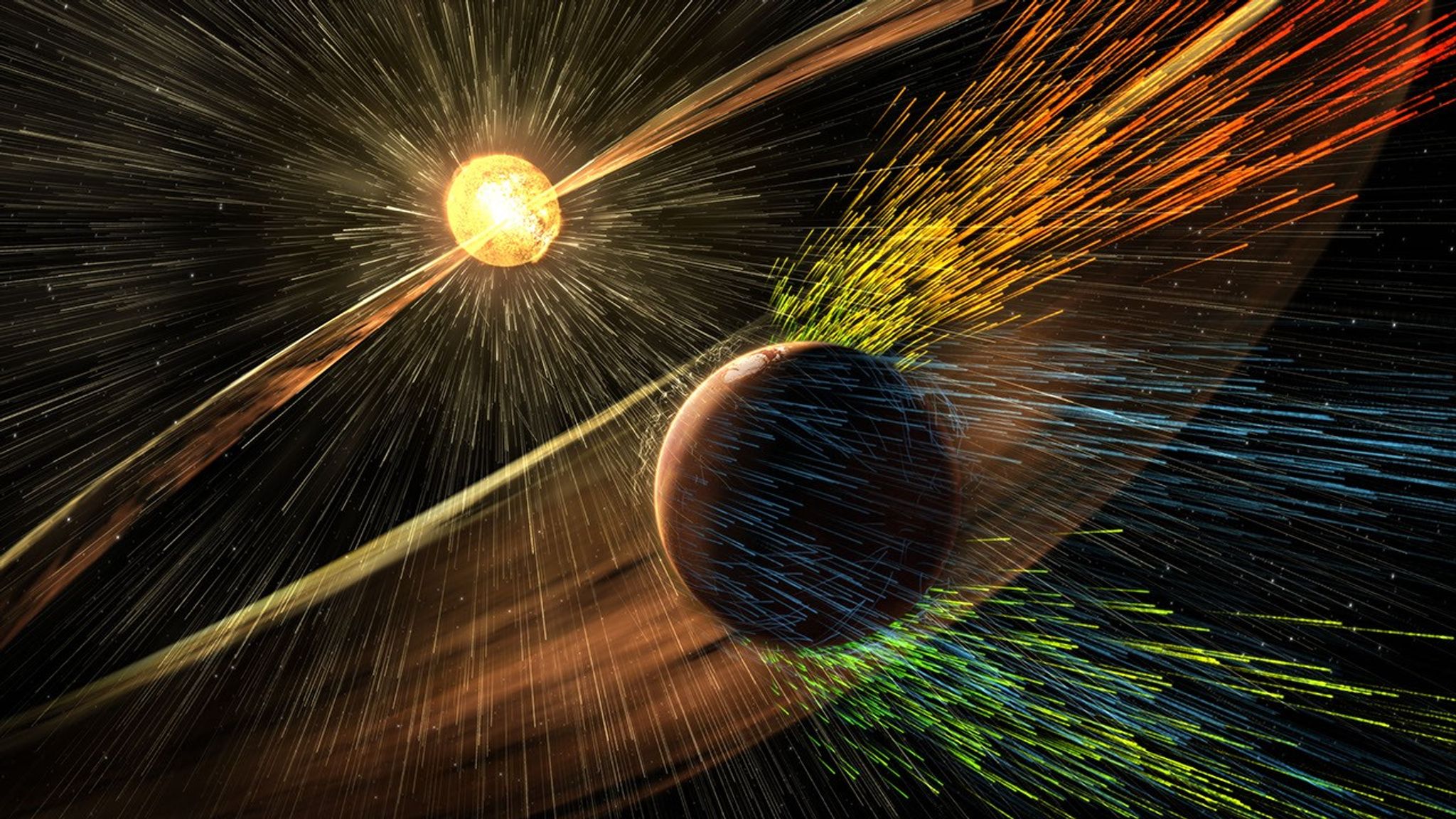
NASA scientists working with the Mars Atmosphere and Volatile Evolution (MAVEN) mission have identified a key process behind the formation of certain auroras on Mars. An illustration from July 23, 2026, depicts charged particles from a solar storm interacting with Mars' atmosphere. This interaction involves the solar storm's particles stripping away charged particles from the Martian atmosphere, contributing to atmospheric loss. This phenomenon is a significant area of study for the MAVEN mission, which aims to understand how Mars lost much of its atmosphere over time. The findings shed light on the dynamic relationship between solar activity and planetary atmospheres, even on worlds far from Earth. Understanding these processes is crucial for comprehending Mars' past habitability and its current environment. The MAVEN mission continues to gather data to further unravel the complexities of Martian atmospheric escape and aurora generation.
The MAVEN mission's findings on Martian auroras offer insight into planetary atmospheric dynamics and the long-term evolution of Mars. By observing how solar storms strip atmospheric particles, scientists can better model the processes that led to Mars' transformation from a potentially habitable world to its current arid state. This research highlights the critical role of stellar wind in shaping planetary environments and underscores the vulnerability of atmospheres, even those of seemingly robust planets. Understanding these mechanisms is essential for future Mars exploration and for contextualizing the search for life beyond Earth, as it informs our understanding of the conditions necessary for habitability across different celestial bodies.
AI-generated to prompt reflection — not editorial opinion, not advice, not a statement of fact. How this works.