NASA Observatories Uncover Secrets of Pulsar in Lighthouse Nebula
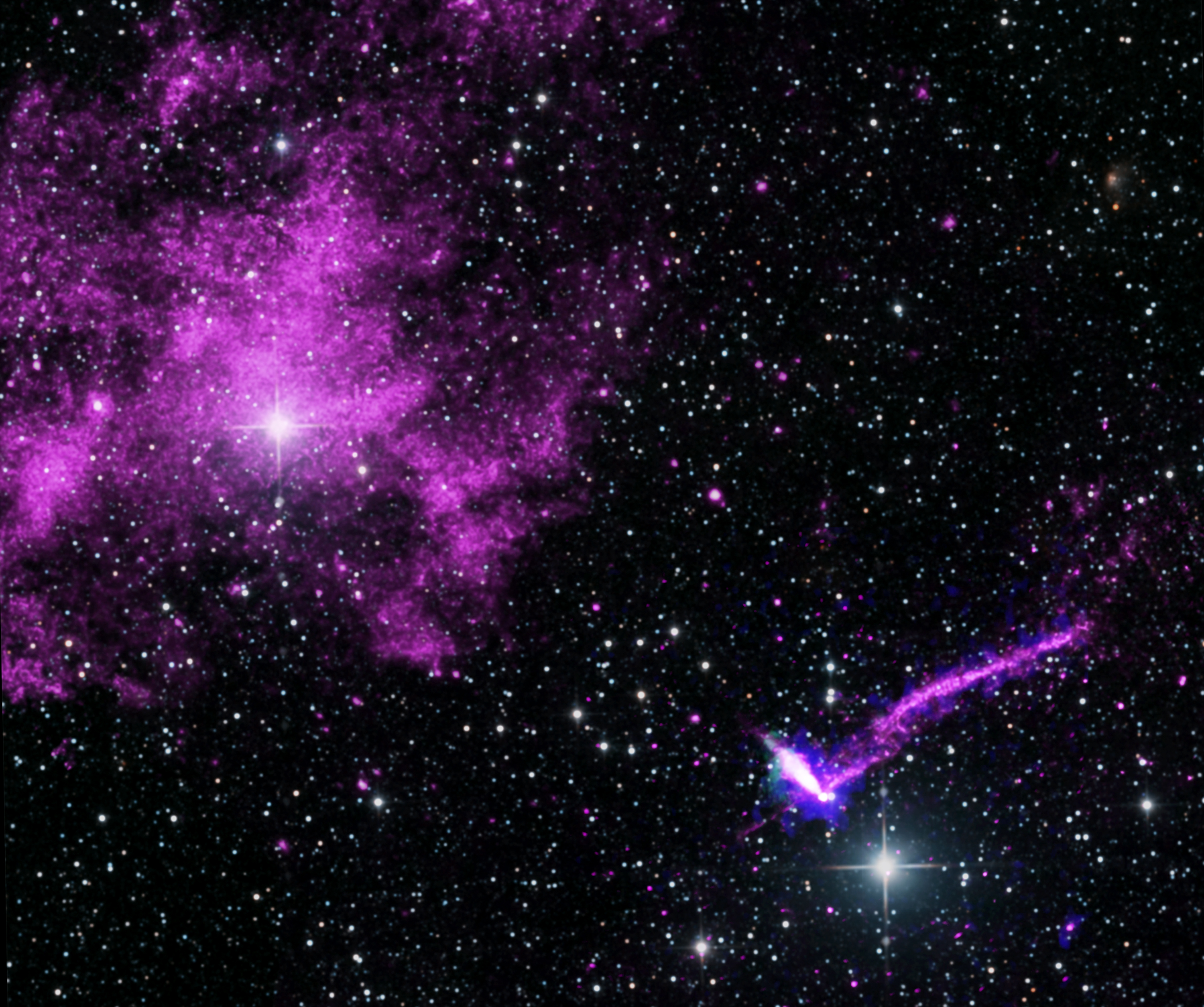
NASA's Chandra X-ray Observatory and the Imaging X-ray Polarimetry Explorer (IXPE) have collaborated to study a pulsar located within the Lighthouse Nebula. This composite image, released on July 9, 2026, combines X-ray data from both observatories. Chandra's observations are represented in purple, while IXPE's X-ray data is shown in blue. Pulsars are a type of neutron star characterized by their powerful magnetic fields and extremely rapid rotation. The study aims to deepen our understanding of these extreme celestial objects and the phenomena they generate within their nebular environments. The combined data from Chandra and IXPE allows scientists to analyze the pulsar's emissions and magnetic field properties with unprecedented detail. This research contributes to the broader scientific effort to unravel the mysteries of stellar evolution and the behavior of matter under extreme conditions in space.
The joint observation campaign by NASA's Chandra and IXPE highlights the synergistic capabilities of advanced space-based observatories in probing complex astrophysical phenomena. By combining X-ray imaging and polarimetry, scientists can gain a more comprehensive understanding of pulsars, which are remnants of massive stars. This approach allows for the disentanglement of emission mechanisms and magnetic field structures, crucial for testing theoretical models of neutron star physics. As AI continues to advance data analysis techniques, future studies may leverage these capabilities to identify and characterize a wider range of pulsars and their interactions with surrounding environments, potentially revealing new insights into cosmic ray origins and the fundamental forces governing the universe.
AI-generated to prompt reflection — not editorial opinion, not advice, not a statement of fact. How this works.