NASA Releases Mars Time-Lapse Video from Psyche Probe's Flyby
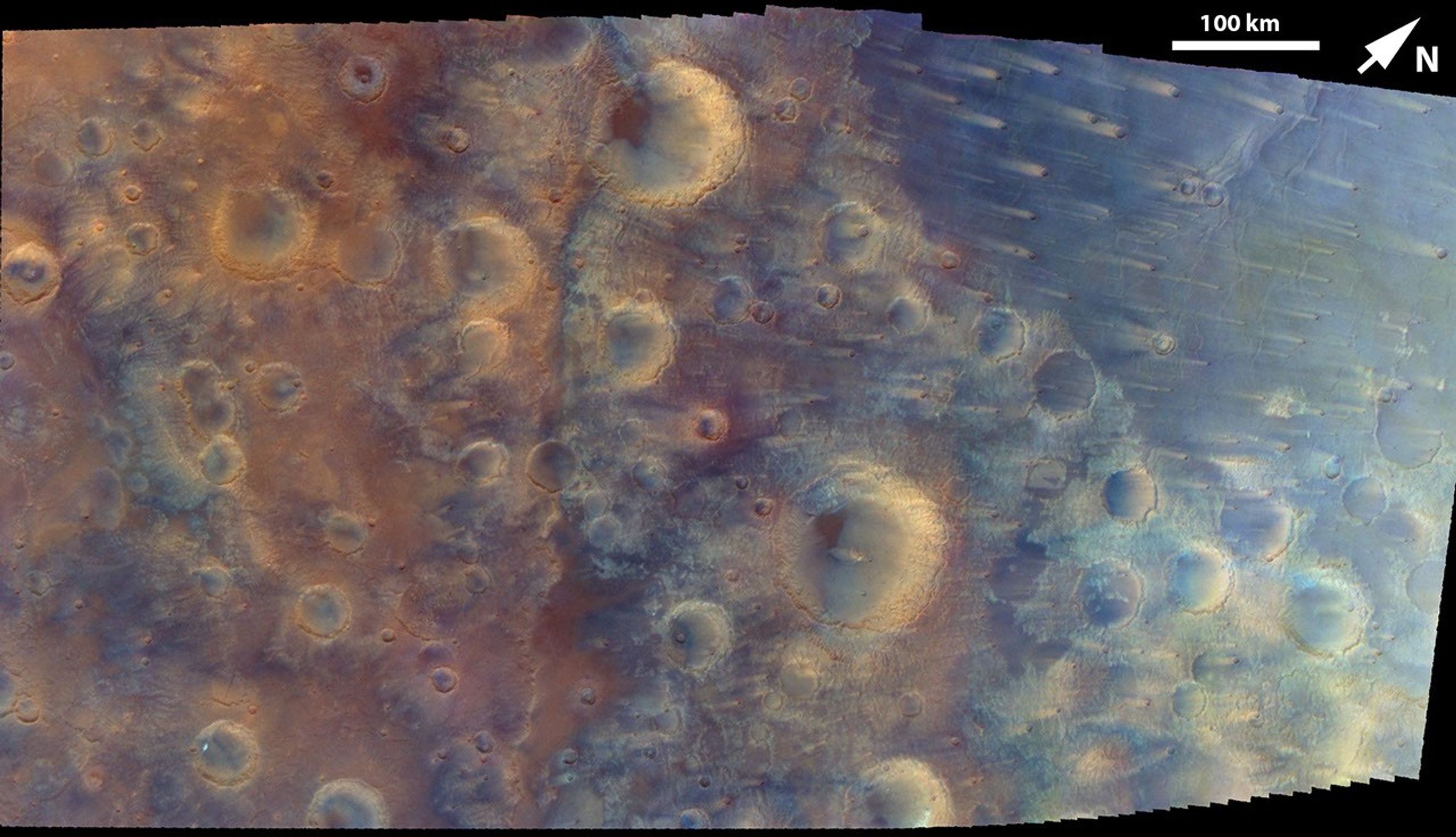
NASA has released a time-lapse video of Mars, compiled from images captured by the Psyche spacecraft during a flyby in May of this year. The Psyche probe, currently en route to an asteroid of the same name, utilized its passage by the Red Planet to gain gravitational momentum for its journey. This encounter also served as a crucial opportunity for scientists to test the probe's scientific instruments. The resulting images showcase detailed Martian surface features, including craters, the southern polar ice cap, and the Huygens crater. NASA stated that this flyby acted as a rehearsal for the observations planned for when the probe reaches the asteroid Psyche, which is anticipated in 2029. Instruments such as imagers, magnetometers, and gamma-ray and neutron spectrometers were calibrated using Mars as a reference, yielding both confirmation of known data and the collection of new information. Lindy Elkins-Tanton, the principal investigator for the Psyche mission from the University of California, Berkeley, noted the teams' diligent efforts and the excellent performance of all instruments. While significant new discoveries about Mars were not the primary objective, the mission successfully contributed to scientific knowledge through the probe's unique vantage point. Launched in 2023, the Psyche mission's ultimate destination is the asteroid belt between Mars and Jupiter, where the Psyche asteroid is believed to be the metallic core of a protoplanet, offering insights into the formation of rocky planets. The gravitational assist from Mars was meticulously planned over several years to ensure the probe's correct trajectory, with arrival at the asteroid expected in 2029 for its main scientific mission.
This event highlights the strategic integration of scientific objectives within deep space missions. By leveraging a planned gravitational assist from Mars for the Psyche probe's trajectory, NASA efficiently tested critical instrumentation. This approach optimizes resource allocation, allowing for dual-purpose data collection—both planetary reconnaissance and mission readiness assessment—without compromising the primary scientific goals. The successful calibration and performance of instruments on a well-studied body like Mars provide a robust baseline for novel investigations of the asteroid Psyche. This demonstrates a systems-thinking approach to space exploration, where each mission phase is designed to yield maximum scientific and operational return, anticipating future challenges and opportunities in understanding planetary formation and resource potential.
AI-generated to prompt reflection — not editorial opinion, not advice, not a statement of fact. How this works.