NASA's IXPE Telescope Maps Magnetic Fields in Pulsar's Cosmic Wake
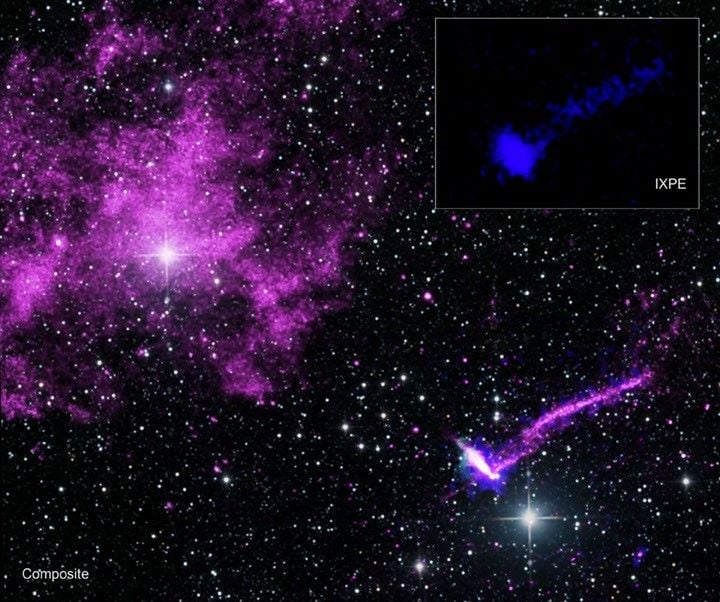
NASA's Imaging X-ray Polarimetry Explorer (IXPE) has successfully mapped the magnetic fields surrounding a "lighthouse" pulsar, revealing crucial details about its energetic cosmic wake. Pulsars are rapidly rotating neutron stars that emit beams of radiation, and when these beams sweep across Earth, they appear to flash like a lighthouse. This particular pulsar, known for its powerful emissions, is located within a nebula created by its own stellar remnant. The IXPE mission, launched in December 2021, is specifically designed to study the polarization of X-rays, which provides information about the magnetic fields in extreme cosmic environments. By analyzing the polarized X-rays from the pulsar's vicinity, scientists can infer the strength and orientation of the magnetic fields that shape the surrounding nebula and influence the behavior of charged particles. This groundbreaking observation offers new insights into the physics of pulsars and the processes that generate high-energy radiation in the universe. The data collected by IXPE will help refine models of pulsar emission and the interaction of these objects with their interstellar surroundings. The findings are expected to advance our understanding of astrophysical phenomena and the fundamental forces at play in the cosmos.
The successful mapping of magnetic fields around a pulsar by NASA's IXPE telescope represents a significant advancement in observational astrophysics. This capability allows for a more precise understanding of the mechanisms driving pulsar emissions and their impact on surrounding nebulae, moving beyond theoretical models to empirical data. The application of X-ray polarimetry to such extreme environments offers a novel lens through which to view fundamental physics, potentially revealing discrepancies between current theories and observed phenomena. Future research will likely focus on leveraging this technique to probe other high-energy cosmic sources, thereby deepening our comprehension of the universe's most energetic processes and their long-term evolution within the galactic context.
AI-generated to prompt reflection — not editorial opinion, not advice, not a statement of fact. How this works.