NASA's Juno Spacecraft Maps Heat Beneath Io's Surface
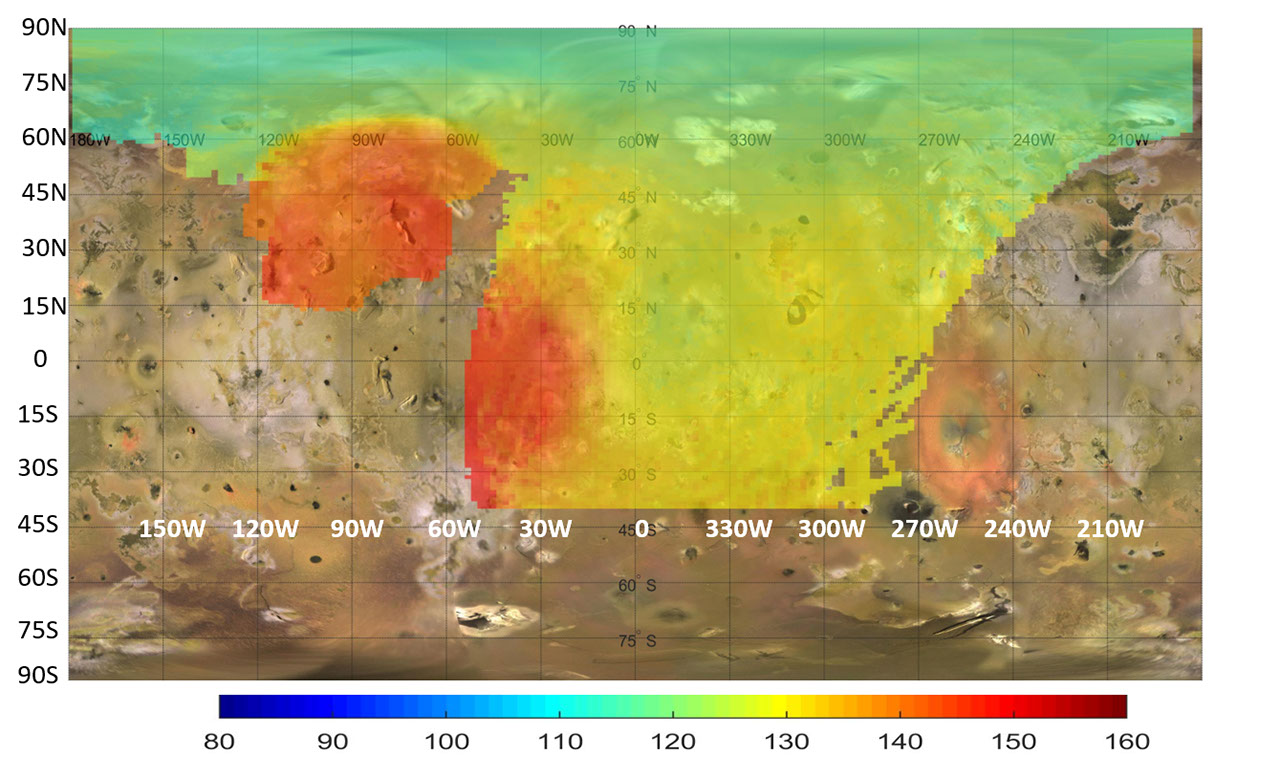
NASA's Juno spacecraft has captured data revealing heat emanating from beneath the surface of Jupiter's moon, Io. This information was gathered using the Microwave Radiometer (MWR) instrument on board Juno. Unlike infrared instruments that measure surface temperature, the MWR's lower frequency microwave channels, specifically at 0.6 and 1.25 gigahertz, can penetrate deeper into the moon's crust. These channels can probe depths of approximately 6 to 15 kilometers (about 4 to 9 miles) below Io's surface. This capability allows scientists to observe thermal emissions from subsurface regions, offering a unique perspective on the moon's internal processes. Io is known for its extreme volcanic activity, driven by tidal forces from Jupiter. Understanding the subsurface heat distribution is crucial for comprehending the mechanisms fueling this intense volcanism. The data collected by Juno's MWR provides valuable insights into the thermal structure of Io's interior, complementing surface observations and enhancing our knowledge of this dynamic Jovian moon.
The Juno mission's observation of subsurface heat on Io provides a novel dataset for understanding volcanic processes driven by tidal heating. By utilizing microwave radiometry, scientists can probe deeper than traditional infrared measurements, offering a more comprehensive view of Io's internal thermal structure. This capability is particularly significant for a moon characterized by extreme volcanism, allowing for a more nuanced analysis of the energy sources and distribution mechanisms. Future research can leverage this data to refine models of tidal dissipation and volcanic activity, potentially revealing insights into the composition and state of Io's interior. Understanding these dynamics contributes to the broader scientific endeavor of characterizing planetary bodies within our solar system and the diverse geological processes they exhibit.
AI-generated to prompt reflection — not editorial opinion, not advice, not a statement of fact. How this works.