NASA's MAVEN Mission Reveals Martian Auroras Share Earth-Like Formation Mechanisms
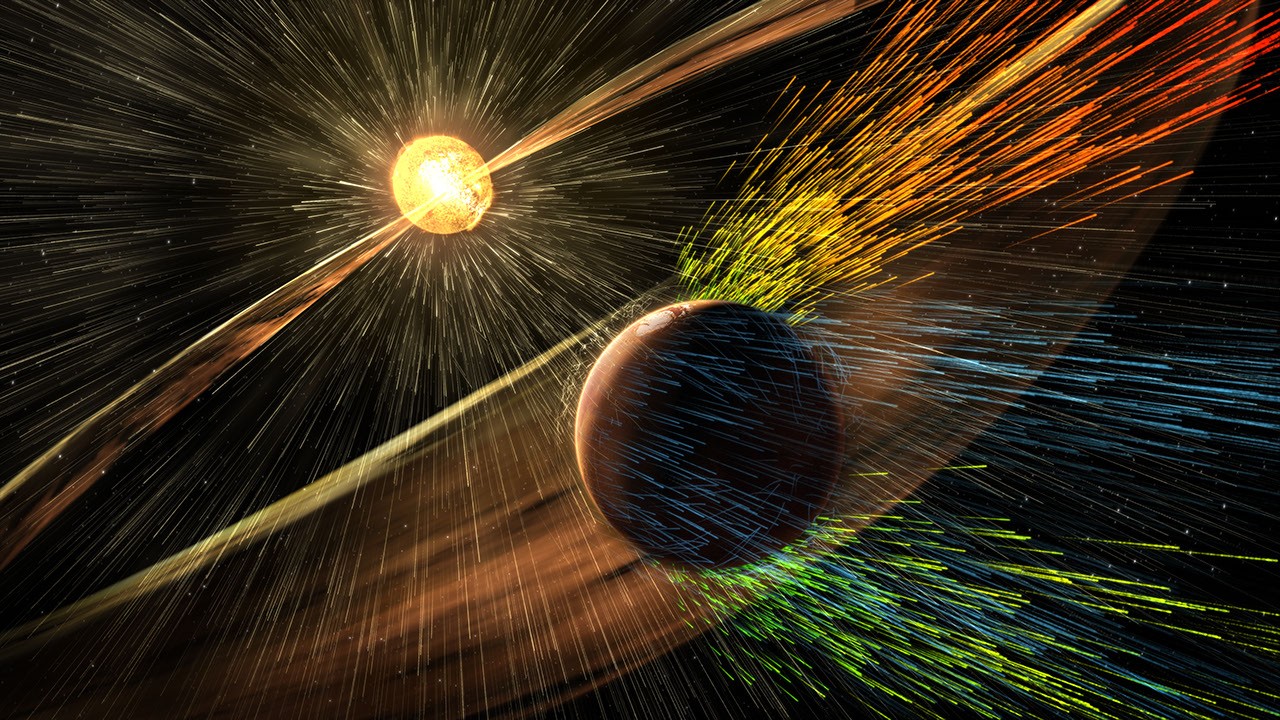
NASA's Mars Atmosphere and Volatile Evolution (MAVEN) mission has shed new light on the formation of certain auroras on Mars, revealing similarities to processes observed on Earth. Scientists discovered that the same mechanism responsible for circulating and ejecting charged particles into Earth's atmosphere is also at play on the Red Planet. These findings, published on Thursday in the journal Nature Communications, represent a significant step in unraveling the complexities of Martian atmospheric phenomena. Understanding these auroras helps scientists better comprehend the dynamics of Mars' atmosphere and its evolution over time. The MAVEN spacecraft continues to provide crucial data, enabling deeper insights into the interactions between the solar wind and the Martian environment. This research contributes to the broader scientific effort to study planetary atmospheres and space weather. The implications extend to understanding habitability and the potential for past or present life on Mars. Further analysis of MAVEN's data is expected to yield additional discoveries about Mars' atmospheric processes.
The MAVEN mission's findings on Martian auroras offer a valuable comparative perspective on planetary atmospheric dynamics. By identifying shared mechanisms with Earth's auroras, the research provides a more robust framework for understanding solar wind interactions across different planetary environments. This comparative approach is crucial for developing predictive models of space weather and atmospheric loss, which are increasingly relevant as humanity expands its presence in space. The identification of common physical processes underscores the universality of certain astrophysical phenomena, while also highlighting the unique evolutionary paths of planetary atmospheres. Future research may leverage these insights to refine our understanding of habitability factors on Mars and other celestial bodies.
AI-generated to prompt reflection — not editorial opinion, not advice, not a statement of fact. How this works.