NASA's Perseverance Rover Examines Organic Carbon on Mars
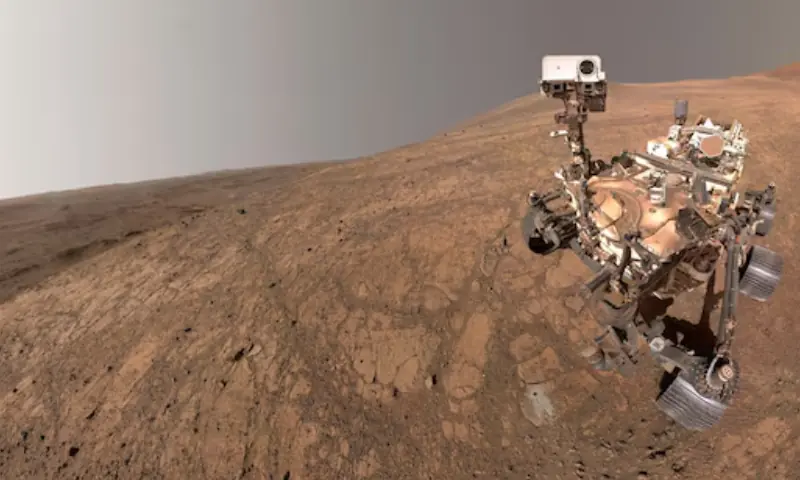
NASA's Perseverance rover is providing scientists with a more detailed understanding of organic carbon found on Mars, a key element in the search for past life. New research published in Science Advances analyzes the structure of macromolecular carbon discovered in sedimentary rock within Jezero Crater. This mudstone, formed between 3.2 and 3.8 billion years ago when the crater held a body of water, contains potential biosignatures. Organic carbon is crucial because it forms the basis of molecules essential for life, such as DNA and proteins, though it can also be produced by nonbiological processes like water-rock interactions. The rover identified this complex carbon in two rocks, Cheyava Falls and Walhalla Glades, located approximately 330 feet apart. Initial observations of the Cheyava Falls rock revealed fine-grained, rusty-red mudstone with features that, on Earth, can be associated with microbial activity. Using the SHERLOC instrument, researchers found that this macromolecular carbon resembles carbon formed by both biological and nonbiological processes on Earth, as well as abiotic processes observed in meteorites. This marks the first discovery of macromolecular carbon in Jezero Crater mudstones, though NASA's Curiosity rover previously detected it in Gale Crater, about 2,300 miles away. Scientists suggest these findings indicate that Mars may have been widely habitable with available organic materials billions of years ago, strengthening the possibility of ancient Martian life. However, they emphasize that this evidence does not confirm life's presence and that definitive answers require sample return to Earth for more advanced laboratory analysis. Mars, now cold and dry, once possessed a thicker atmosphere and liquid water, conditions considered vital for life's emergence.
The ongoing investigation into organic carbon on Mars by the Perseverance rover highlights the intricate challenge of identifying extraterrestrial life. While the presence of organic molecules is a necessary precursor for life as we know it, their abiogenesis or biogenesis remains a critical ambiguity. The current research, focusing on macromolecular carbon in Jezero Crater, underscores the limitations of in-situ analysis for definitively distinguishing between biological and geological origins. Future sample return missions are essential for applying higher-resolution terrestrial laboratory techniques, which will be crucial for resolving these complex questions. This endeavor reflects a broader scientific imperative to understand life's potential ubiquity in the universe, by rigorously examining environments that once possessed conditions favorable for habitability, thereby informing our understanding of planetary evolution and the conditions under which life might arise beyond Earth.
AI-generated to prompt reflection — not editorial opinion, not advice, not a statement of fact. How this works.