NASA's PUNCH Mission Demonstrates Enhanced Solar Storm Prediction Accuracy
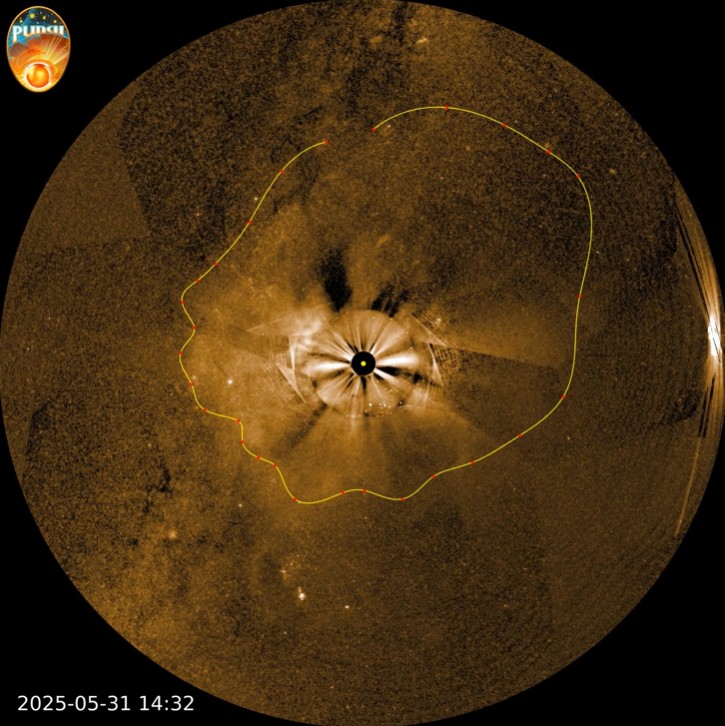
NASA's PUNCH (Polarimeter to Unify the Corona and Heliosphere) mission has successfully demonstrated its capability to improve solar storm forecasting. In a recent proof-of-concept test, scientists utilized continuous imagery from the PUNCH mission to predict the arrival time of a solar eruption near Earth with remarkable precision, narrowing the window to within 30 minutes. These promising results were presented on Tuesday at the Committee on Space Research Scientific Meeting. The findings are currently under review for publication in the journal Space Weather. This advancement holds significant potential for enhancing our ability to anticipate and prepare for space weather events that can impact Earth and its technological infrastructure.
The successful demonstration by NASA's PUNCH mission highlights a critical advancement in space weather forecasting. By providing continuous imagery, the mission offers a more dynamic and granular view of solar eruptions, moving beyond static models. This enhanced predictive capability can significantly mitigate risks associated with solar storms, which pose threats to satellite operations, power grids, and communication systems. The ability to forecast arrival times with greater precision allows for more effective preparedness measures, potentially saving billions in infrastructure damage and ensuring continuity of essential services. As our reliance on technology grows, the importance of such predictive tools will only increase, underscoring the need for continued investment in solar observation and forecasting.
AI-generated to prompt reflection — not editorial opinion, not advice, not a statement of fact. How this works.
