NASA's Swift Telescope Detects Rare 'Wandering' Black Hole Devouring a Star
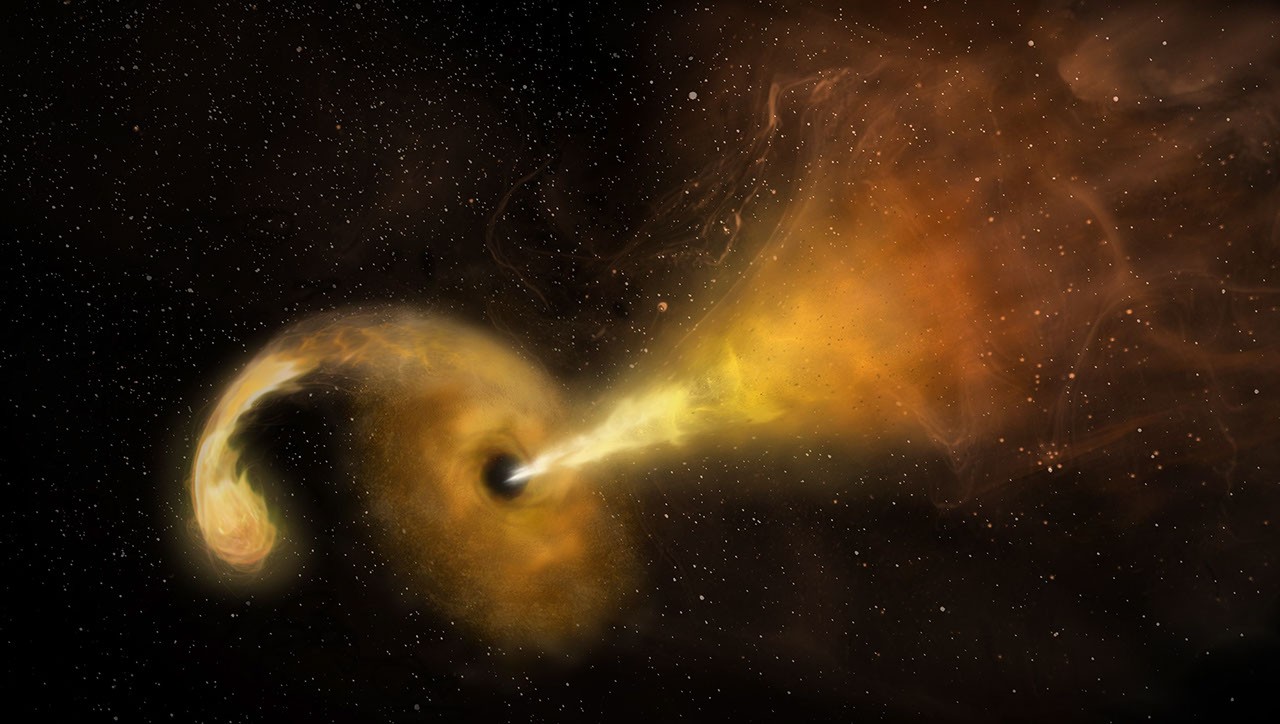
NASA's Neil Gehrels Swift Observatory has detected an unusual event where a "wandering" black hole, located far outside a galaxy's core, was observed consuming a star. This phenomenon, known as a tidal disruption event, is rarely witnessed, and this instance is particularly noteworthy because it occurred on the outskirts of a distant galaxy. Typically, such events are observed closer to the galactic center. The Swift Observatory's instruments were specifically designed to search for these star-shredding events, which offer valuable insights into the behavior of black holes and their interactions with surrounding matter. The detection of this "orphan" black hole actively feeding on a star provides astronomers with a unique opportunity to study these extreme cosmic occurrences in an unprecedented location. Further analysis of the light emitted during this event could reveal more about the black hole's mass, its trajectory, and the composition of the star it consumed. This discovery underscores the vastness and complexity of the universe, highlighting phenomena that challenge existing astrophysical models.
The observation of a "wandering" black hole consuming a star far from a galactic center presents a rare astrophysical event. This discovery offers valuable data for refining models of black hole distribution and behavior, particularly concerning their mobility and gravitational influence outside dense galactic cores. Understanding the mechanisms that propel black holes into such "orphan" trajectories and the frequency of these events is crucial for a comprehensive galactic census. Future research may focus on identifying similar occurrences to determine if these events are more common than previously thought, potentially impacting our understanding of galactic evolution and the dynamics of stellar populations in intergalactic space. The data gathered could also inform theories on the formation and evolution of supermassive black holes.
AI-generated to prompt reflection — not editorial opinion, not advice, not a statement of fact. How this works.