National Liberation Council Protests Privatization of 44 State-Owned Industries
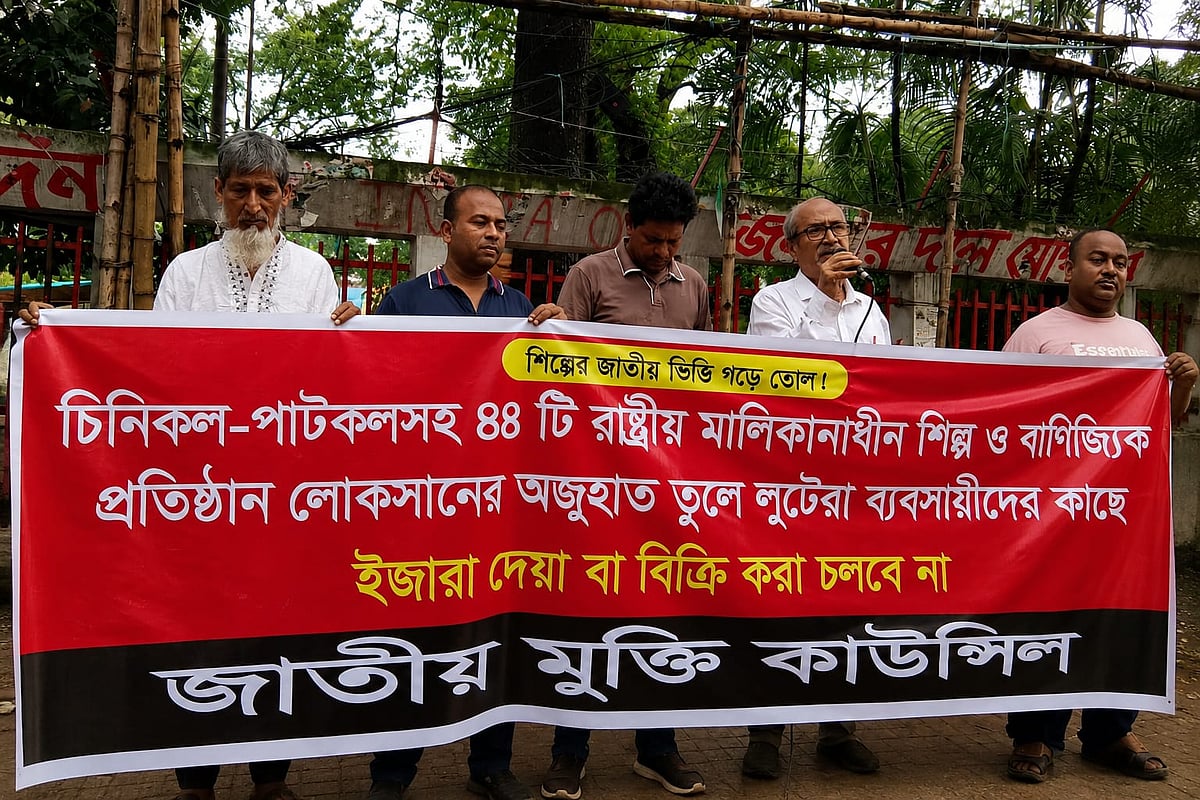
The National Liberation Council has protested the government's initiative to lease or sell 44 state-owned industrial and commercial enterprises to private owners, citing alleged losses as a pretext. The organization argues that these state assets should be modernized and managed under state control rather than being transferred to the private sector. They further allege that this move serves the interests of exploitative business groups rather than the public good. The protest took place on Tuesday in front of the National Press Club. The council also claimed that earlier the same day, the government held a meeting with bureaucrats and businessmen to determine policies for leasing or selling these 44 state-owned entities.
During the rally, central coordinator Foyjul Hakim stated that despite the fall of the Sheikh Hasina government in the July uprising, the country remains under the exploitation of a predatory business class. He accused syndicate businessmen of destabilizing the market and creating a crisis for young people due to a lack of employment. Hakim asserted that instead of building heavy industries and a national industrial base, the government is moving to privatize state industries. He specifically mentioned sugar mills and jute mills among the 44 enterprises being considered for transfer, calling it an act to protect business interests and urging workers, farmers, and students to resist.
Other leaders, Heman Das and Deepa Mallick, voiced additional concerns. Das called for the cancellation of a trade agreement with the United States signed during the Professor Muhammad Yunus government, arguing that economic policy should not be dictated by foreign powers. Mallick recalled the closure of 25 jute mills and 6 sugar mills by the Awami League government in 2020, which rendered thousands jobless. She attributed the decline of state-owned industries to corruption, lack of investment in modernization, and collusion between bureaucrats and businessmen, rather than inherent losses. Saifur Rudra criticized the silence of opposition political parties on the current privatization initiative, drawing a parallel to the 2002 closure of Adamjee Jute Mills under the BNP government, which the Awami League did not oppose. He urged workers and farmers to remain vigilant.
The National Liberation Council's protest highlights a recurring tension between state-led industrial policy and privatization, particularly in the context of economic performance and governance. The council's framing of the issue as a conflict between 'exploitative business groups' and the public interest, while emotionally charged, points to a broader concern about rent-seeking behavior and the potential for corruption in the transfer of state assets. The analysis of historical precedents, such as mill closures under previous administrations, suggests a pattern of political decision-making influenced by vested interests rather than purely economic rationale. The call for modernization and state management, contrasted with the privatization of industries allegedly weakened by corruption and underinvestment, raises questions about the capacity and incentives of state institutions versus private actors. The critique of foreign trade agreements and external economic guidance reflects a nationalistic perspective on economic sovereignty. Moving forward, a key challenge for policymakers will be to ensure transparency and accountability in asset management, whether public or private, to foster genuine industrial development and public welfare, rather than perceived or actual enrichment of select groups.
AI-generated to prompt reflection — not editorial opinion, not advice, not a statement of fact. How this works.