National Professor Calls for Repatriating Export Earnings to Foster Self-Reliance
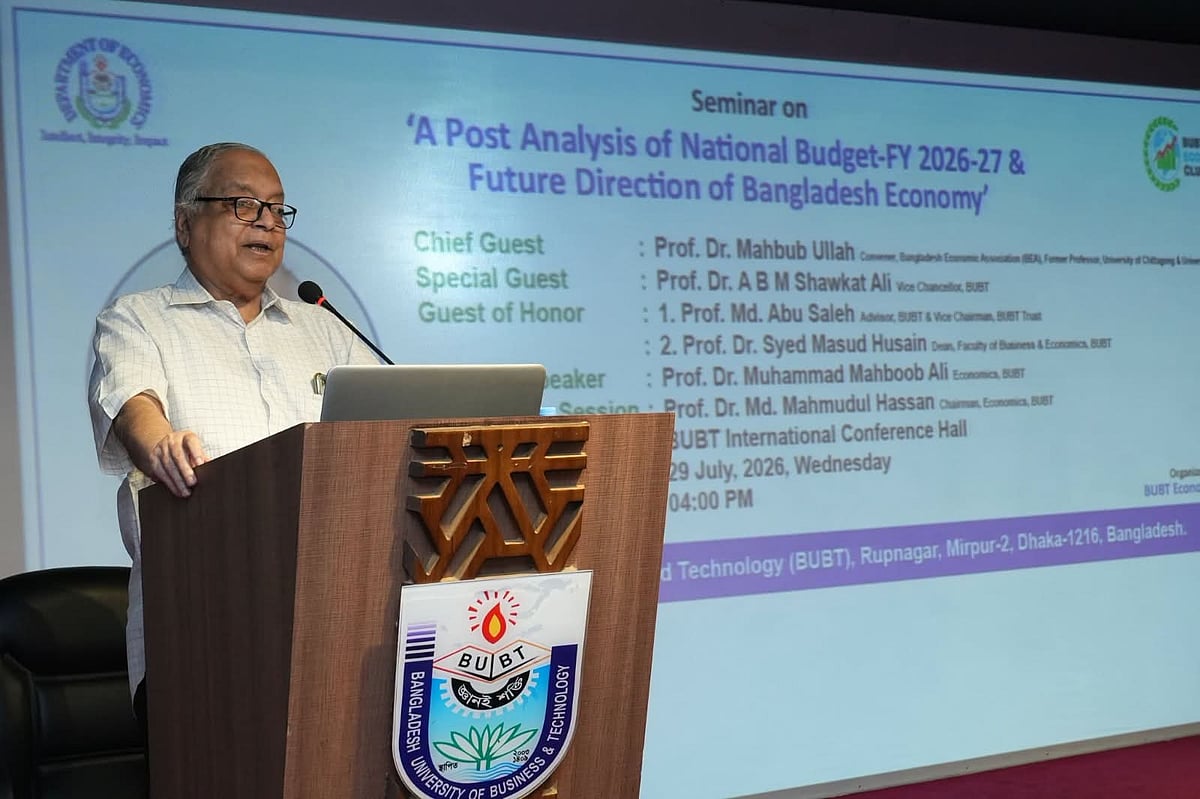
National Professor Mahbub Ullah has emphasized Bangladesh's need to shift from external financial dependence towards self-reliance, particularly after 50 years of development. He stressed that repatriating export earnings back into the country is crucial for achieving this goal. Professor Ullah made these remarks at a seminar organized by the Economics Club of Bangladesh University of Business and Technology (BUBT). The event, held at BUBT's international conference hall last Wednesday, focused on analyzing the national budget for fiscal year 2026-27 and outlining future directions for the Bangladeshi economy. During his keynote address, Professor Ullah presented a holistic view on critical issues such as resource distribution, income inequality, and economic stability, highlighting the necessity of identifying primary sources for investable capital to drive the nation's progress. He specifically pointed out the need to make the ready-made garment sector self-sufficient and ensure that export revenues are brought back into the country. Professor Ullah also attributed the low tax-to-GDP ratio to an unorganized National Board of Revenue (NBR) and noted that significant national resources are consumed by debt interest payments, hindering budget implementation. He further cited the high expenditure of mega-projects undertaken during the previous government's tenure as a cause for current high inflation. The seminar also featured a presentation by Professor Muahammad Mahbub Ali of BUBT's Economics Department, who analyzed the FY2026-27 budget and underscored the importance of implementing the Annual Development Programme (ADP) with a focus on quality control for successful project outcomes. Professor Ali also suggested that electricity distribution should remain under the current system, rather than being privatized, to ensure transparency and prevent corruption.
The call to repatriate export earnings and reduce reliance on external financing suggests a strategic pivot towards domestic economic consolidation. This emphasis on self-sufficiency, particularly after decades of development, reflects a common aspiration for developing nations seeking to strengthen their economic sovereignty. However, achieving this requires addressing systemic issues such as the low tax-to-GDP ratio and the burden of debt servicing, which divert resources from productive investment and development initiatives. The critique of mega-projects' high costs and their contribution to inflation points to the critical need for robust fiscal discipline and efficient public expenditure management. Moving forward, fostering domestic value addition and ensuring that export revenues are effectively reinvested domestically will be key determinants of Bangladesh's long-term economic resilience and sustainable growth trajectory in the coming decade.
AI-generated to prompt reflection — not editorial opinion, not advice, not a statement of fact. How this works.