Nato Unveils Multi-Billion Dollar Arms Deals Amid Calls for Increased Defense Spending
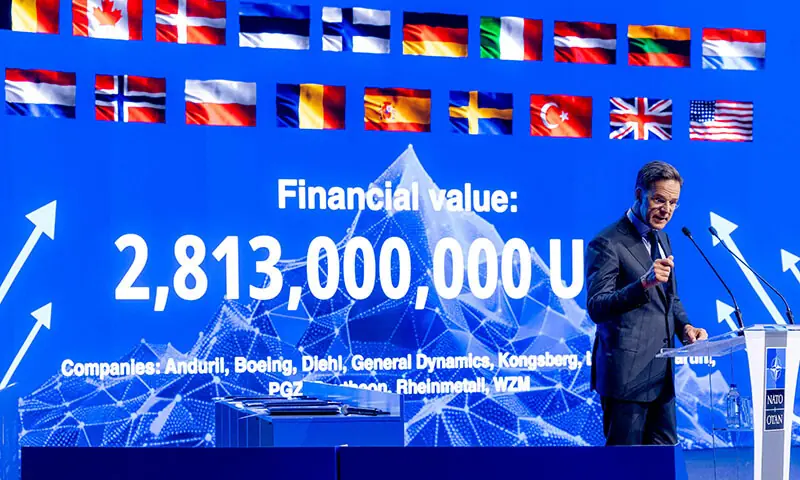
Nato leaders announced significant arms deals totaling tens of billions of dollars in Ankara, Turkey, on Tuesday, emphasizing a collective response to US calls for increased defense contributions. Secretary General Mark Rutte urged a "revolution" in the alliance's defense industry, citing concerns over Russia's military buildup and threats from China, North Korea, and Iran. Rutte stressed the immediate need for enhanced capabilities, stating, "We don't have the luxury of time." The initiatives aim to boost Western arms manufacturers' capacity and encourage long-term government orders, addressing historical fragmentation and reliance on US weaponry within Europe's defense sector. Key deals include European nations purchasing surveillance drones from Northrop Grumman and Nato acquiring aircraft from Sweden's Saab, whose shares rose significantly on the news. Lockheed Martin and Rheinmetall are also set to jointly produce ATACMS missiles in Germany, marking the first non-US manufacturing of this weapon. Nato allies plan to invest over $40 billion in anti-drone capabilities within the next five years. These announcements precede a summit with US President Donald Trump, who has consistently criticized European defense spending and reliance on the US. Rutte reported that European Nato members and Canada increased defense spending by $90 billion in real terms in 2025 compared to 2024, reaching over $570 billion. A potential shift in US-Turkey relations may see Trump indicating readiness to allow Turkey's return to the F-35 fighter program, from which it was removed after acquiring Russian S-400 systems. Tensions have also been exacerbated by the US conflict with Iran, with Trump criticizing Nato members for insufficient support. Nato members are expected to pledge approximately $80 billion in assistance to Ukraine in 2026, a commitment underscored by recent Russian attacks on Kyiv.
This event highlights a strategic pivot within Nato, driven by both perceived external threats and internal political pressure from the United States. The substantial arms deals signal a renewed focus on military readiness and technological advancement, particularly in areas like drone defense. This rearmament push, while framed as a collective security measure, also reflects a complex interplay of geopolitical incentives and economic opportunities for defense contractors. The increased spending, especially in light of US calls for burden-sharing, suggests a potential recalibration of transatlantic defense responsibilities. Looking ahead, the emphasis on indigenous European defense production, as seen with the ATACMS deal, could signify a long-term strategy to reduce reliance on US supply chains, a dynamic that may accelerate in an era of increasing global competition and potential technological decoupling.
AI-generated to prompt reflection — not editorial opinion, not advice, not a statement of fact. How this works.