NCT Leads Container Handling for Fourth Consecutive Year, RSGT Shows Rapid Growth
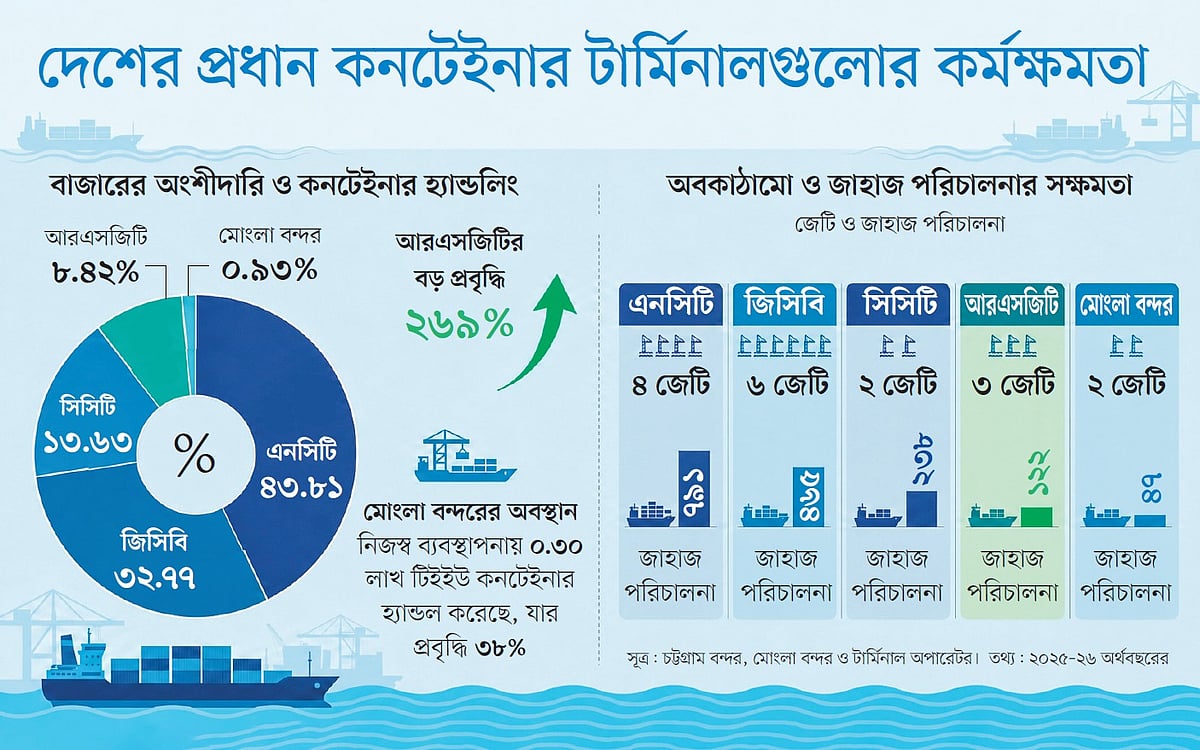
The New Mooring Container Terminal (NCT) in Chittagong, Bangladesh, has maintained its top position in container handling for the fourth consecutive fiscal year, according to data from the fiscal year 2025-26. In the recently concluded fiscal year, NCT handled 1.385 million TEUs (Twenty-foot Equivalent Units), an increase of approximately 8% from the previous year. This terminal, now managed by the naval organization Chittagong Dry Dock Limited, was previously operated by Saif Powertech Limited and is currently undergoing a transition to be managed by UAE-based port operator DP World.
The General Cargo Berth (GCB), once the primary container handling facility in Bangladesh since 1977, has fallen to second place, handling 1.036 million TEUs in FY25-26, a decrease of 8.24% from the prior year. GCB, which has been operational since 1954 and 1979, handles both container and general cargo. NCT surpassed GCB in container volume for the first time in FY2017-18, and has consistently held the lead since FY2022-23. The Chittagong Container Terminal (CCT), the third-largest, saw a significant drop of 21% in container handling, processing 431,000 TEUs in the last fiscal year. CCT's older gantry cranes have experienced downtime, impacting its performance.
Saudi Arabia's Red Sea Gateway Terminal (RSGT), operating as RSGT Chittagong, has demonstrated remarkable growth. Since commencing commercial operations in June 2024, its container volume surged by approximately 268% in the last fiscal year, reaching 279,000 TEUs. The terminal aims to handle 500,000 TEUs in the current fiscal year with the planned installation of new gantry cranes. Meanwhile, the Mongla port, handling about 1% of the nation's total container traffic, saw a 38% increase, handling 29,751 TEUs. While competition among terminals is seen as positive, industry leaders suggest setting a maximum tariff instead of a fixed one to further benefit users and foster genuine competition based on service quality and efficiency.
The shift in container handling leadership from the established General Cargo Berth (GCB) to the New Mooring Container Terminal (NCT) highlights the impact of modernization and investment in port infrastructure. NCT's sustained dominance, particularly with the integration of modern gantry cranes, underscores the operational advantages of advanced equipment. The significant growth of RSGT Chittagong indicates the potential for new entrants to rapidly capture market share through strategic deployment of technology and potentially competitive pricing models. The decline in volumes at CCT, attributed to aging equipment, points to the critical need for continuous capital expenditure to maintain competitiveness in the logistics sector. While increased competition among terminals is generally beneficial for trade efficiency, the article notes that true user-driven competition is not yet fully realized, suggesting that regulatory frameworks may need to evolve to ensure equitable market access and transparent pricing structures that truly benefit importers and exporters.
AI-generated to prompt reflection — not editorial opinion, not advice, not a statement of fact. How this works.