Neptune's Inner Moons and Rings Likely Formed from Shattered Ice Worlds
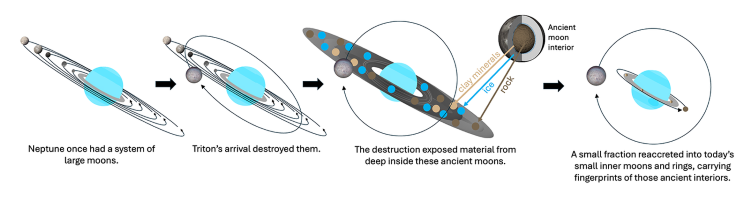
Scientists hypothesize that Neptune's inner moons and rings are remnants of larger, original moons that were destroyed. The planet Neptune possesses 16 known moons, with Triton being the most massive, accounting for over 99.5% of the total mass of all its moons. Triton's substantial size has led to the theory that it was originally a Kuiper Belt object captured by Neptune's gravity. This capture event is believed to have caused significant disruption to Neptune's initial moon system due to Triton's subsequent elliptical orbit. It is thought that some of the debris from these destroyed original moons now constitutes the dusty rings observed orbiting Neptune. The current scientific inquiry focuses on understanding the composition and scale of this primordial moon system, questioning whether they were similar to the smaller moons seen today or fragments of much larger celestial bodies.
The formation of Neptune's moon system, particularly the inner moons and rings, presents a compelling case study in planetary dynamics and gravitational capture. The hypothesis that these features originated from the destruction of larger, pre-existing moons due to Triton's capture highlights the chaotic nature of early solar system formation. Understanding the precise composition and orbital mechanics of these remnants can provide crucial insights into the conditions and processes that shaped planetary systems. Future research could leverage advanced simulations and observational data to further refine models of this event, potentially revealing broader implications for the stability and evolution of exoplanetary systems and the prevalence of ring systems around gas giants.
AI-generated to prompt reflection — not editorial opinion, not advice, not a statement of fact. How this works.