New AI Framework 'ManCAR' Significantly Enhances Recommendation Systems
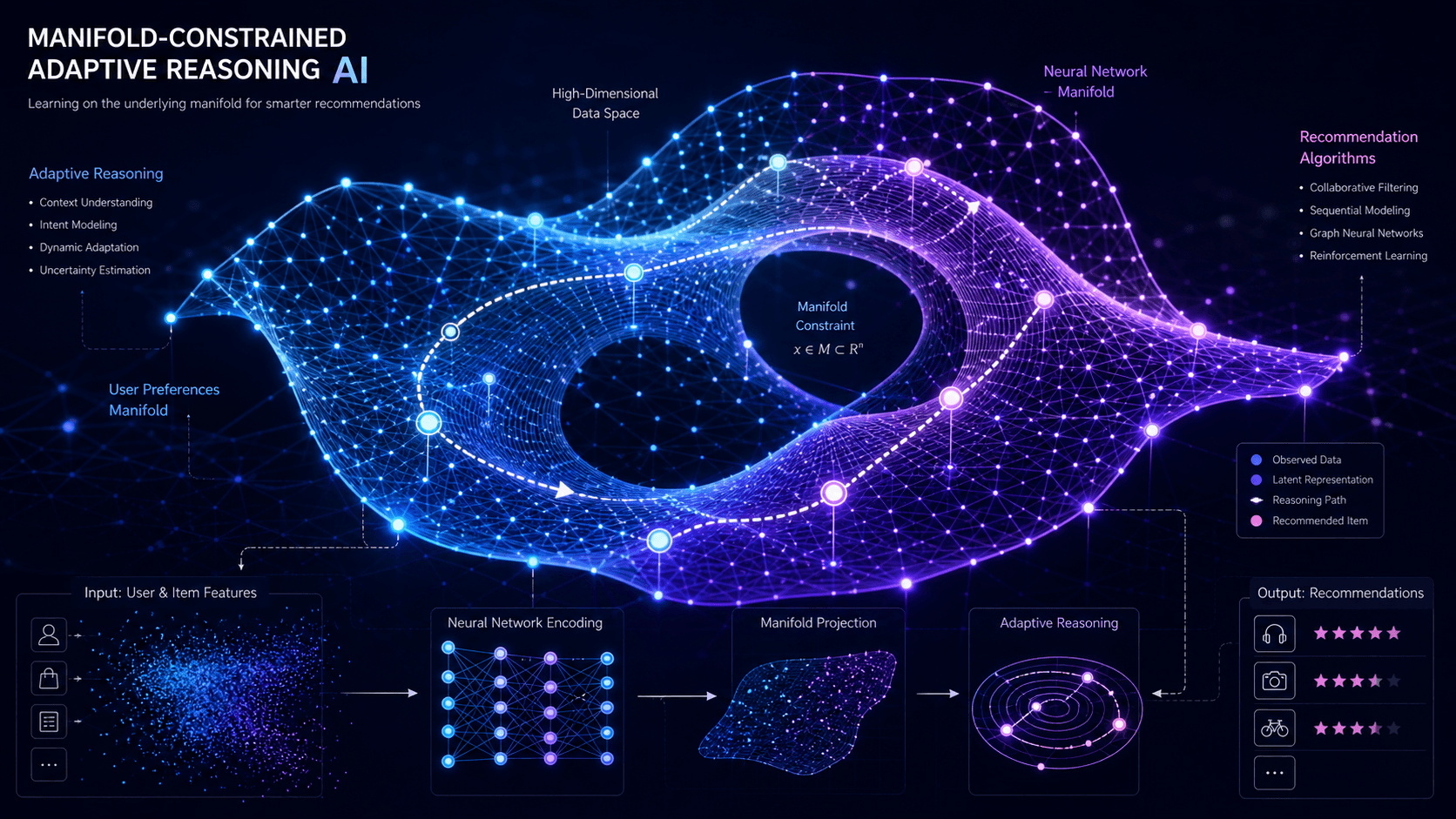
Researchers led by Fu Cong from Xiamen University have introduced ManCAR, a novel manifold-constrained adaptive reasoning framework designed to improve generative recommendation systems. This innovative approach aims to boost the accuracy and effectiveness of personalized recommendations. The framework leverages manifold constraints and adaptive reasoning to better understand user preferences and item relationships. Early testing has demonstrated substantial improvements in recommendation performance. Specifically, ManCAR achieved an impressive NDCG@10 score increase of up to 46.88%. This significant enhancement suggests ManCAR's potential to revolutionize how recommendation engines operate across various platforms. The development represents a notable advancement in the field of artificial intelligence and its application to user-centric services. The team's work at Xiamen University highlights a commitment to pushing the boundaries of AI-driven personalization.
The development of ManCAR by Fu Cong's team at Xiamen University introduces a sophisticated adaptive reasoning framework for generative recommendation systems. By incorporating manifold constraints, the system aims to capture complex user-item interactions more effectively than traditional methods. The reported 46.88% improvement in NDCG@10 suggests a significant leap in recommendation quality, potentially leading to more engaging user experiences and improved platform engagement metrics. This advancement aligns with the broader trend of leveraging advanced AI techniques to enhance personalization, moving beyond simple collaborative filtering or content-based approaches. The focus on adaptive reasoning indicates a system capable of learning and adjusting to evolving user behaviors and item landscapes, a critical capability in dynamic digital environments. Future research could explore the scalability of ManCAR and its performance across diverse datasets and recommendation tasks, as well as its potential for explainability.
AI-generated to prompt reflection — not editorial opinion, not advice, not a statement of fact. How this works.