New Bangladesh Dream Will Fail If Politics Remains Backward-Looking: Mujeebur Rahman
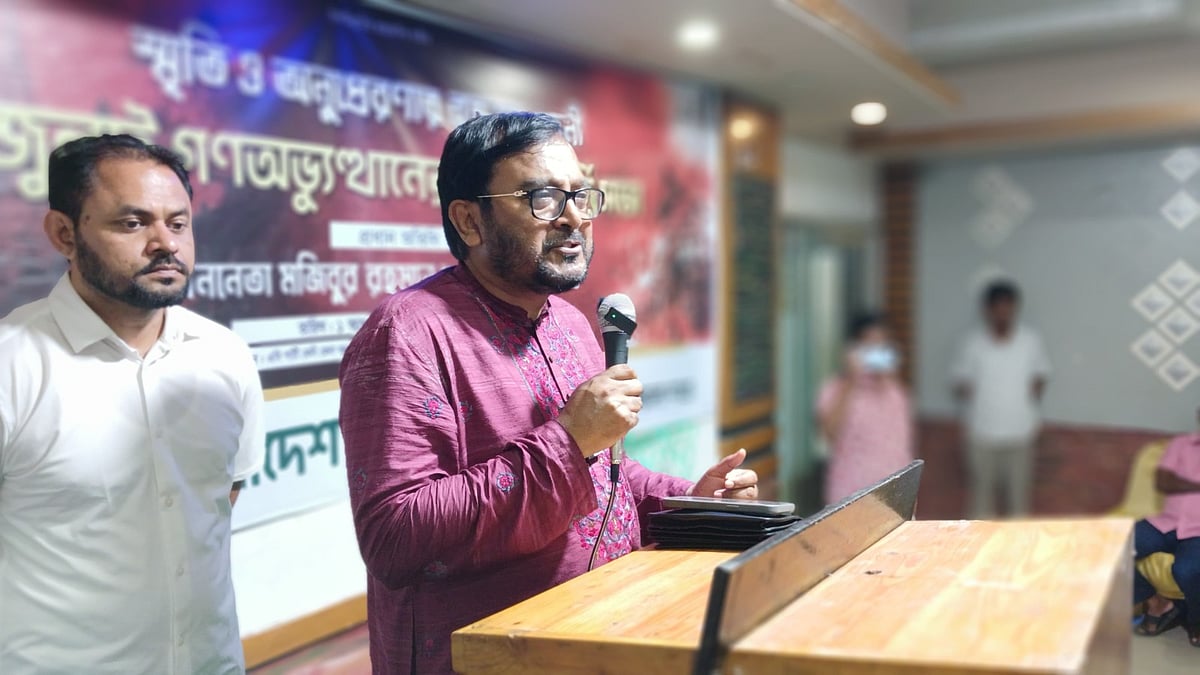
Mujeebur Rahman Bhuiyan, chairman of the Amar Bangladesh Party (AB Party), stated that using undignified and vulgar language in criticism, as well as retaliatory attacks and vandalism, are unacceptable and indicative of fascist behavior. He asserted that both abusive language and attacks represent backward-looking politics, and if this trend is not abandoned, the dream of a new Bangladesh will be jeopardized. Rahman made these remarks as the chief guest at a rally organized by the Feni district AB Party on Saturday afternoon to commemorate the second anniversary of the July uprising. The event took place at the party's district office on Mizan Road, presided over by district convener Ahsan Ullah and moderated by district secretary Fazlul Haque. Rahman also noted that while the July uprising had successes and failures, those who claim credit for its achievements must also accept responsibility for its shortcomings. He called for unity among all forces of the July uprising to counter the resurgence of fascism. Mohaimin Tajim, senior joint secretary of the National Citizen Party's Feni district branch, expressed a desire to move beyond politics of vengeance and work together for a Bangladesh free from discrimination. The meeting also featured speeches from Neshar Ahmed, father of martyr Ishtiaq Ahmed Srabon; Maulana Anwar Hossain, father of martyr Md. Ikram Hossain Kausar; Mufti Abdul Hannan, Feni district chief of Jamaat-e-Islami; Salahuddin Mamun, president of Feni district Chhatra Dal; Shah Wali Ullah, secretary of the National Citizen Party; Rashid Majumder, joint secretary of the district Chhatra Dal; and Md. Saif Uddin, president of Jagpa's Feni district unit.
The statement critiques a political climate characterized by personal attacks and violence, framing it as a hindrance to national progress and a manifestation of 'fascist' tendencies. The analysis highlights the inherent tension between celebrating past struggles and addressing present failures, suggesting a need for accountability from those who benefited from past movements. The call for unity against perceived 'fascism' and the desire for a non-discriminatory Bangladesh reflect common aspirations in post-conflict or politically charged environments. Moving forward, the focus on constructive political engagement over retaliatory tactics will be crucial for realizing any vision of a 'new Bangladesh,' especially in an era where digital communication can amplify both dissent and division.
AI-generated to prompt reflection — not editorial opinion, not advice, not a statement of fact. How this works.