New fossil reptile discovered in Brazil predates dinosaurs and crocodiles
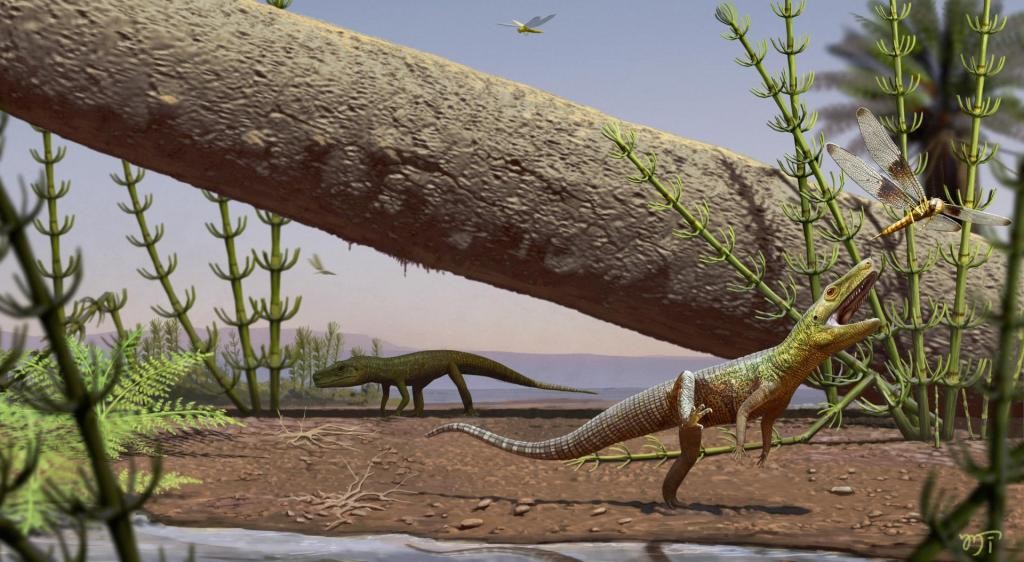
Paleontologists in Rio Grande do Sul, Brazil, have unearthed a fossil of a new reptile species, Silescelida acristata, dating back approximately 240 million years to the Middle Triassic period. This discovery, made in Dona Francisca within the UNESCO Quarta Colônia Geopark, sheds light on a crucial evolutionary stage for archosauriforms, the group that would later give rise to dinosaurs and crocodiles. The find helps fill a significant gap in understanding the early evolution of these reptiles, which emerged after the Permian-Triassic extinction event, the largest mass extinction in Earth's history.
Silescelida acristata was a small, slender, quadrupedal animal, comparable in size to a small caiman. It likely occupied the niche of a small predator, feeding on smaller prey. Its semi-erect leg posture, indicated by its femur, suggests a more efficient locomotion that was a precursor to the anatomical changes enabling the success of later archosaurs. This fossil is particularly important because it may be related to the Euparkeriidae family, a rare group of archosauriforms previously known primarily from Africa, Asia, and Europe. Its presence in South America significantly expands the known geographic distribution of this group, highlighting the continent's role in early vertebrate evolution.
The formal description of Silescelida acristata was only possible after a crucial fragment of the fossil, lost for over two decades, was rediscovered in 2022 at the Pontifical Catholic University of Rio Grande do Sul (PUCRS). The species name reflects this history: 'Silescelida' combines 'silence' and 'leg,' referencing the long period the fossil was hidden and the limb bones preserved, while 'acristata' means 'without crest,' referring to the absence of a specific bony prominence on its femur. This discovery reinforces Rio Grande do Sul's status as a key global site for studying Triassic fauna and the reorganization of terrestrial ecosystems following the Permian-Triassic extinction.
The discovery of Silescelida acristata in Brazil offers a valuable window into the adaptive radiation of archosauriforms following a major extinction event. The fossil's anatomical features, particularly its limb posture, illustrate a critical transitional phase in the evolution of locomotion efficiency, a key factor in the subsequent dominance of archosaurs. The expanded geographic range suggested by this find challenges previous assumptions about the distribution of early archosauriform lineages, emphasizing the need for continued paleontological exploration across South America. Understanding these early diversification patterns is crucial for comprehending the long-term resilience and evolutionary trajectories of terrestrial vertebrate ecosystems in the face of environmental upheaval.
AI-generated to prompt reflection — not editorial opinion, not advice, not a statement of fact. How this works.