New HBF Spec Aims to Boost GPU Memory with Advanced NAND Stacking and High Bandwidth
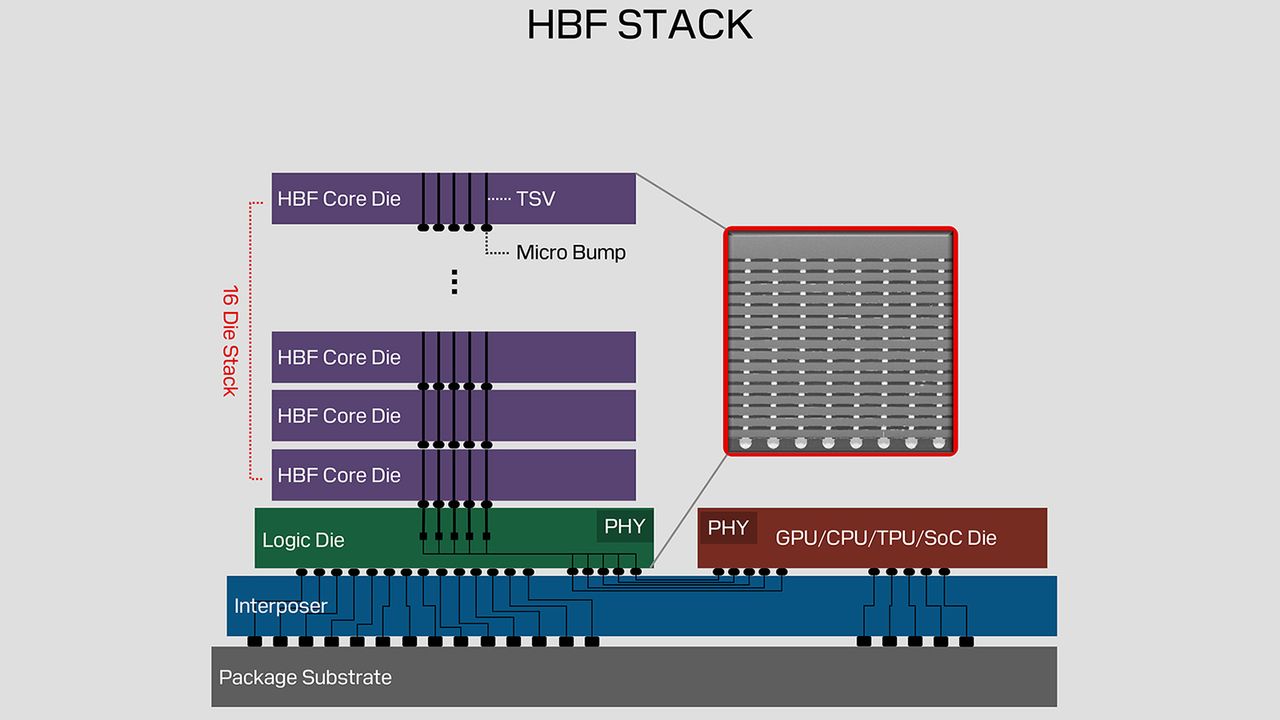
SanDisk and SK Hynix have officially unveiled the Hybrid Bumping Flow (HBF) specification, a new technology designed to significantly enhance GPU memory capabilities. This specification enables the use of up to 16-Hi NAND stacks, a method of layering memory chips vertically. The HBF technology promises to deliver an impressive bandwidth of up to 3 TB/s, a substantial increase over current standards. This advancement aims to provide GPUs with terabytes of additional memory capacity. However, interest in the new specification appears limited at this early stage, with only four companies currently expressing a desire to adopt the technology. The specification also incorporates Universal Chiplet Interconnect Express (UCIe) for improved chip-to-chip communication.
The introduction of the HBF specification by SanDisk and SK Hynix represents a significant technological push to address the escalating memory demands of modern GPUs, particularly in the context of AI and high-performance computing. The proposed 16-Hi NAND stacks and 3 TB/s bandwidth could alleviate memory bottlenecks, a critical factor in accelerating complex computations. The limited initial interest from only four companies suggests potential challenges in ecosystem adoption, possibly related to manufacturing costs, integration complexity, or the need for further standardization and validation. As the industry moves towards more modular and interconnected chip architectures, technologies like HBF, leveraging UCIe, are poised to play a crucial role in future system designs. The long-term success will depend on broader industry collaboration and the demonstration of clear performance and cost advantages over existing solutions.
AI-generated to prompt reflection — not editorial opinion, not advice, not a statement of fact. How this works.
