New Zealand and India Forge Strategic Partnership, Boosting Defense and Security Ties
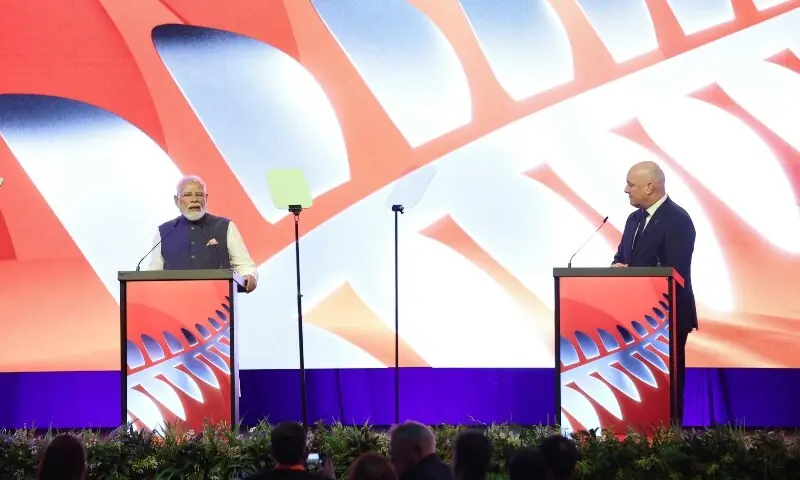
New Zealand and India have officially established a "strategic partnership" focused on defense and security, announced during the landmark visit of Indian Prime Minister Narendra Modi on Saturday. New Zealand Prime Minister Christopher Luxon welcomed Modi with traditional Maori customs, aiming to deepen bilateral relations following the signing of a free-trade agreement in April. This visit, part of Modi's tour of the Indo-Pacific, occurs amidst regional tensions heightened by China's recent missile tests. It marks the first visit by an Indian prime minister to New Zealand in four decades, signifying India's increased engagement in a region with a growing Chinese presence. The new partnership encompasses enhanced defense cooperation, including naval exercises, alongside strengthened collaboration in trade, diplomacy, culture, sports, and science. Both nations affirmed a shared commitment to a "free, open, peaceful and prosperous Indo-Pacific." Prime Minister Luxon indicated that New Zealand is seeking diverse international relationships to bolster its security and economic prosperity, without directly commenting on whether the new alliance would counter Chinese influence. The visit also highlights the significant Indian diaspora in New Zealand, with a large community event planned in Auckland. However, the free-trade agreement faces domestic opposition, particularly concerning immigration provisions, with some coalition partners expressing concerns about potential impacts on New Zealand's labor market and culture. Separately, inflammatory remarks by a fringe religious figure targeting Indian religious groups have drawn widespread condemnation.
The establishment of a strategic partnership between New Zealand and India represents a significant geopolitical alignment, driven by shared democratic values and a mutual interest in regional stability within the Indo-Pacific. This move can be analyzed through the lens of diversifying international relationships in response to evolving global power dynamics, particularly concerning China's growing influence. For New Zealand, a smaller nation, such partnerships are crucial for enhancing security and economic opportunities, creating a "multi-lattice" of alliances rather than relying on a single dominant partner. The domestic debate surrounding the free-trade agreement, however, reveals a tension between economic liberalization and national identity concerns, a common challenge for many developed economies navigating increased global interconnectedness. Future developments will likely hinge on how effectively both nations balance their strategic objectives with domestic political considerations and the broader implications for regional trade and security architectures.
AI-generated to prompt reflection — not editorial opinion, not advice, not a statement of fact. How this works.