Newton's Cradle Illusion Explained: Battery and Magnet Power the Perpetual Motion
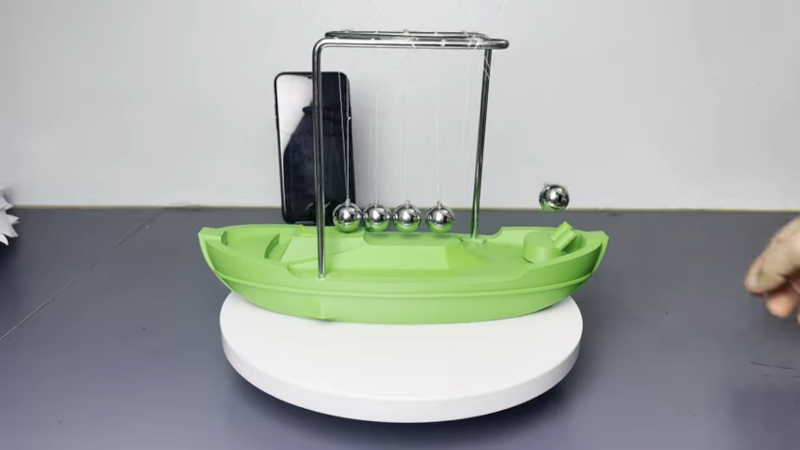
A common perception is that a Newton's cradle, when set in motion, can continue swinging indefinitely. However, this is a misconception, as demonstrated by a recent project by user [dongvua90]. The illusion of perpetual motion in a Newton's cradle is typically achieved through the hidden use of a battery and a magnet. These components are strategically placed to provide the continuous energy input required to overcome friction and air resistance. Without this external power source, a traditional Newton's cradle would quickly come to a stop due to energy dissipation. The project highlights how simple mechanical toys can be enhanced with hidden technology to create seemingly magical effects. This underscores the importance of understanding the underlying mechanisms behind everyday phenomena, especially when they appear to defy basic physical principles.
The demonstration of a seemingly perpetual Newton's cradle challenges conventional understanding by revealing hidden energy inputs. This highlights a broader societal tendency to accept phenomena at face value without scrutinizing underlying mechanisms, particularly when technology is integrated seamlessly. As AI and automation become more pervasive, discerning between true autonomy and externally powered systems will be crucial. Understanding these distinctions is vital for informed decision-making and for preventing the uncritical adoption of technologies that may have hidden dependencies or limitations. This serves as a reminder to investigate the energy flows and control systems in all complex demonstrations.
AI-generated to prompt reflection — not editorial opinion, not advice, not a statement of fact. How this works.