NZ Foreign Minister's 'go back' remark sparks spat with China's envoy
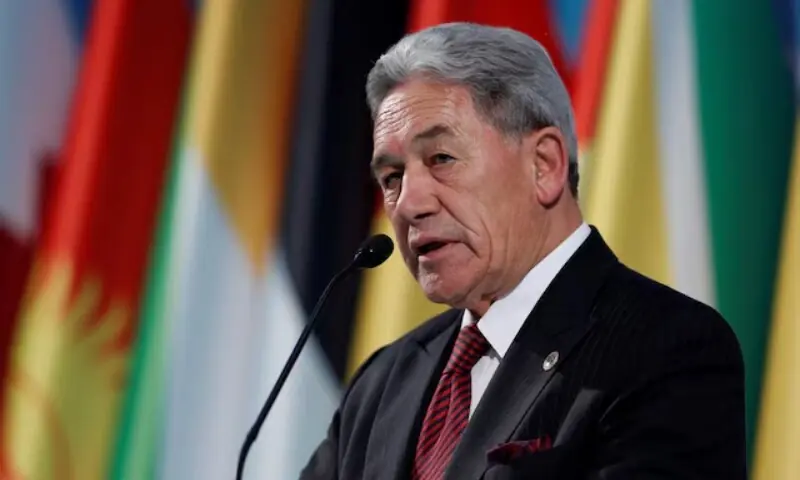
New Zealand's Foreign Minister Winston Peters ignited a public dispute with Beijing's ambassador in Wellington after telling a Chinese-born lawmaker to "go back to your own country." The incident occurred during a debate on the country's COVID-19 response on Wednesday. Lawrence Xu-Nan, a Green Party member born in Tianjin, China, and raised in Auckland, questioned Peters about his vaccination status. Peters responded by suggesting Xu-Nan had recently arrived in New Zealand and should return to his country of origin, contrasting New Zealand's democracy with the lawmaker's presumed political background. The remarks drew a rare public statement from Chinese Ambassador Wang Xiaolong on Thursday, who implied Peters' comments reflected more on himself than the target. Peters retorted on X, asserting his words demonstrated New Zealand's commitment to free speech and democratic rights, which he contrasted with limitations in other countries. This is not the first time Peters or his NZ First party have faced accusations of racism. Previously, Deputy Shane Jones criticized a trade deal with India, and both he and Peters made controversial remarks about immigrants during parliamentary debates, with Peters telling Xu-Nan and another MP to "show some gratitude" for being in New Zealand.
This exchange highlights the tension between nationalistic rhetoric and diplomatic engagement. Foreign Minister Peters' populist approach, characterized by direct and provocative language towards a lawmaker of Chinese descent, appears intended to resonate with a domestic audience concerned about immigration and national identity. However, such statements carry significant diplomatic risks, as evidenced by the Chinese ambassador's public rebuke. The incident underscores the challenge of balancing domestic political messaging with the complexities of international relations, particularly with major trading partners. In the evolving geopolitical landscape, where economic interdependence is intertwined with ideological differences, leaders must navigate the potential for inflammatory rhetoric to escalate into broader diplomatic friction, impacting trade and foreign policy objectives.
AI-generated to prompt reflection — not editorial opinion, not advice, not a statement of fact. How this works.