Old Myanmar Port Explosion Video Falsely Claimed as Border Airstrike
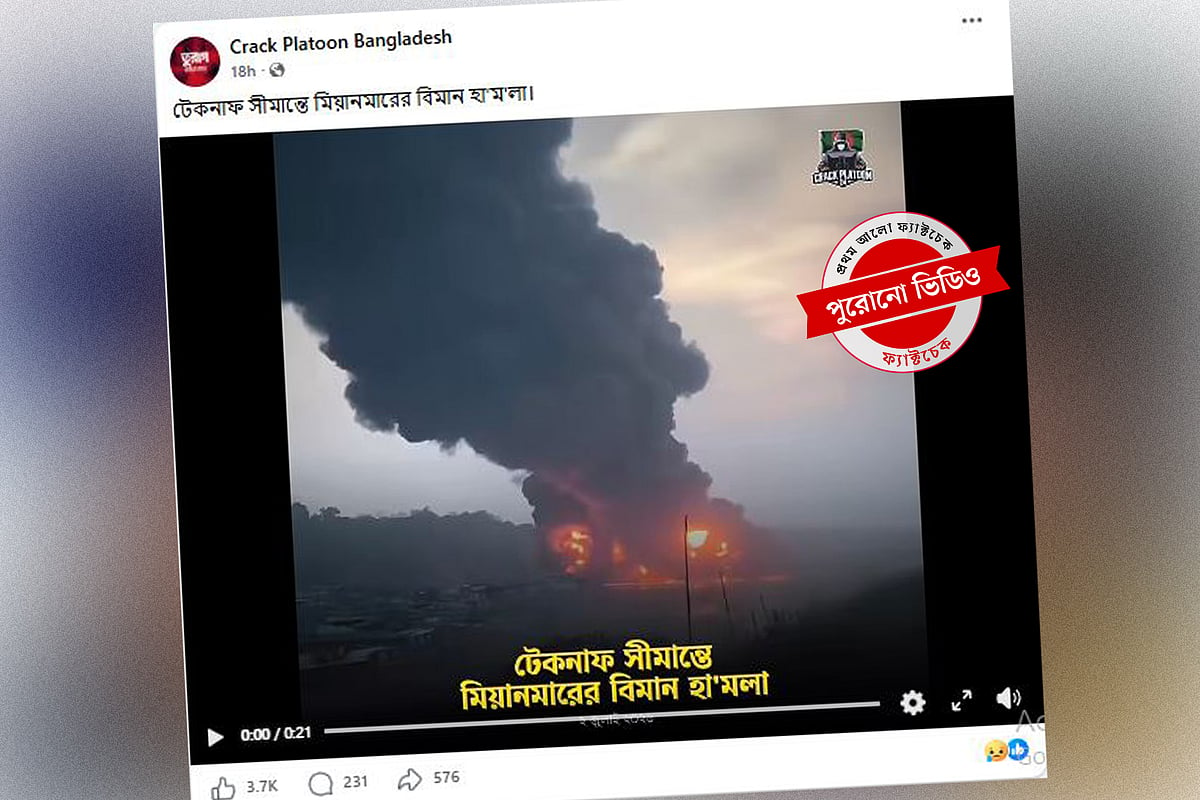
A 21-second video widely circulated on social media, claiming to show an airstrike by Myanmar across the Teknaf border, has been debunked as old footage. The video depicts a severe fire and thick smoke engulfing multiple vessels, vehicles, and structures at a river port. Initially shared by a Facebook page named Crack Platoon Bangladesh, the video garnered over 150,000 views and nearly 4,000 reactions. It was also previously published by Indian media outlet Republic TV and several Bangladeshi online news outlets, lending it apparent credibility. Many viewers expressed concern and panic, believing the video depicted the current situation at the Teknaf border. However, an investigation revealed the video is unrelated to recent events. Reverse image searches of the video's key frames led to a 36-second video posted on Facebook on April 21st of this year by a user named Leakana Meas. The Cambodian caption translated to Bengali indicated a severe fire on multiple fuel tankers at Myanmar's Homalin port, resulting in several deaths. The viral video is an exact match to this earlier footage. Reports from April 21st by international news agencies like Turkey's Anadolu Agency, India's Firstpost, and Bangladesh's The Financial Express detailed an explosion at the Homalin river port in Myanmar's Sagaing region during fuel transfer operations. The fire rapidly spread to other vessels, vehicles, and port infrastructure, causing at least two deaths and eleven injuries. International media did not link this incident to an airstrike on the Teknaf border. Homalin is located in the Sagaing region, not Rakhine Province, which borders Bangladesh. While a separate First আলো report on July 2nd did cover Myanmar government airstrikes targeting Arakan Army positions near Mongdu in Rakhine State, causing explosions audible at the Teknaf border and creating panic, there is no connection between those events and the viral video. Therefore, the video circulating with claims of a recent airstrike on the Teknaf border is an old recording of a fuel tanker explosion and fire at Myanmar's Homalin port on April 21st, with no relation to the current border situation.
The dissemination of an old video depicting a port explosion in Myanmar as a recent airstrike on the Teknaf border exemplifies the challenges of combating misinformation in conflict zones. Such misrepresentations can escalate tensions and shape public perception based on fabricated events. The viral spread, amplified by media outlets, highlights the critical need for robust verification processes before reporting or sharing sensitive content. Analyzing the actors involved, the propagation suggests a potential intent to inflame border tensions or capitalize on existing anxieties. From a systems perspective, the ease with which manipulated content bypasses verification mechanisms points to a vulnerability in the digital information ecosystem. Moving forward, enhanced AI-driven detection tools combined with journalistic diligence are essential to counter such narratives and ensure public discourse is grounded in factual reporting, particularly in regions experiencing active conflict.
AI-generated to prompt reflection — not editorial opinion, not advice, not a statement of fact. How this works.