OpenAI Launches Codex Micro: A Programmable AI Control Console
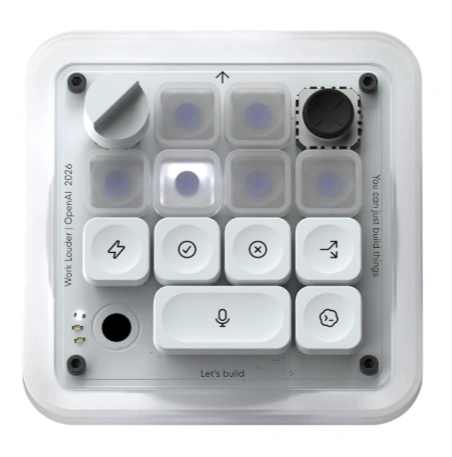
OpenAI has introduced its first commercial hardware product, the Codex Micro, developed in collaboration with manufacturer Work Louder. This device is designed as a control console for users of ChatGPT's specialized programming agent, Codex. The Codex Micro features a sleek, minimalist design with 13 programmable mechanical keys for custom shortcuts and 6 RGB illuminated keys that display the real-time status of Codex agents. It also includes a mini-joystick and a rotary dial for initiating workflows and adjusting the AI's reasoning level. Connectivity options include both Bluetooth and USB-C, and it is compatible with Mac and Windows desktop applications. The device is intended to streamline coding tasks such as writing code, debugging, running tests, and managing repositories by allowing direct execution of these functions with a single button press. Users can customize the device further with interchangeable keycaps, with two switch types available: silent or clicky mechanical. The Codex Micro, priced at $230, was released as a limited edition and is currently sold out. The package includes a set of 32 custom keycaps.
The introduction of the Codex Micro by OpenAI signals a strategic move beyond pure software into dedicated hardware interfaces for AI agents. While presented as a tool to enhance programmer efficiency, its aspirational framing as a potential 'iPhone moment' for AI interaction highlights a broader industry trend: the quest to create intuitive, desirable hardware that bridges the gap between complex AI capabilities and everyday use. The device's limited edition status and current sold-out condition suggest a test of market appetite for specialized AI peripherals. Future iterations may explore broader AI applications beyond programming, potentially democratizing access to advanced AI functions by offering physical, tactile controls. This development raises questions about the long-term evolution of human-computer interaction in the AI era, balancing the power of advanced AI with accessible and user-friendly interfaces.
AI-generated to prompt reflection — not editorial opinion, not advice, not a statement of fact. How this works.