OpenAI Launches GPT-5.6 Family: Luna, Terra, and Sol Models
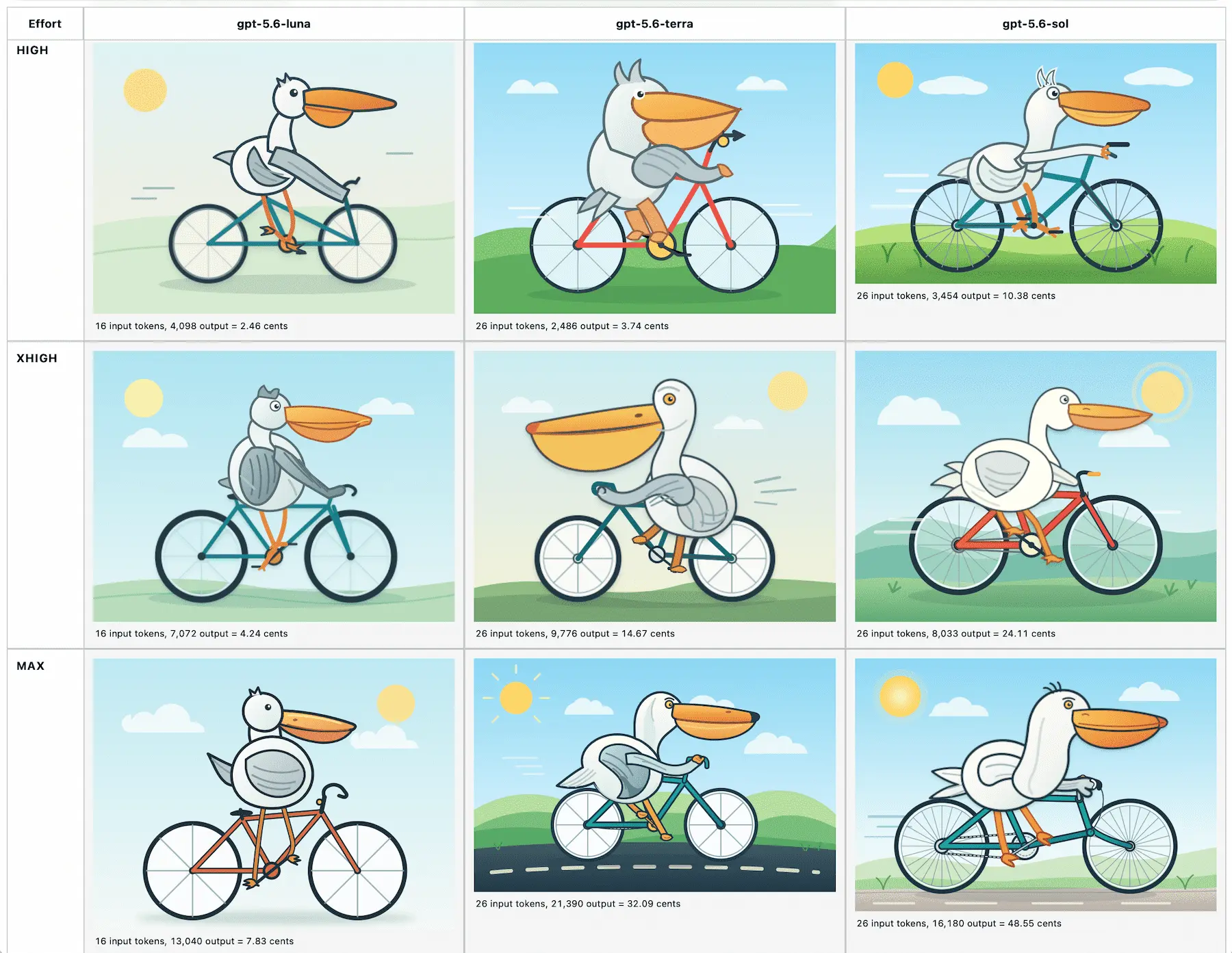
OpenAI has released its new flagship GPT-5.6 model family, comprising three sizes: Luna, Terra, and Sol, from smallest to largest. The models are priced at $1/$6, $2.50/$15, and $5/$30 per 1 million input/output tokens, respectively. OpenAI claims significant advancements in long-running agentic performance, with GPT-5.6 Sol outperforming Claude Fable 5 on the Agents' Last Exam benchmark by 13.1 points, achieving a score of 53.6. Even at medium reasoning, GPT-5.6 Sol reportedly beats Fable 5 by 11.4 points at a considerably lower cost. The efficiency extends to smaller models, with GPT-5.6 Terra and Luna offering superior performance to Fable 5 at a fraction of the cost. However, Claude Fable 5 reportedly outperformed GPT-5.6 Sol on the SWE-Bench Pro benchmark, scoring 80% compared to 64.6%. OpenAI has also raised concerns about the integrity of the SWE-Bench Pro benchmark, estimating that approximately 30% of its tasks may be flawed. New API features include Programmatic Tool Calling for JavaScript orchestration of tool calls, Multi-agent capabilities for parallel work, and Prompt cache breakpoints for explicit cache management. Image requests now support a 'detail: original' option to prevent resizing.
OpenAI's release of the GPT-5.6 family introduces new pricing tiers and performance claims, particularly highlighting improvements in agentic task execution. The company's strategic critique of the SWE-Bench Pro benchmark, concurrent with its own model's lower performance on it, suggests a complex interplay between model development, evaluation methodologies, and competitive positioning. This situation underscores the ongoing challenge in establishing universally accepted and robust benchmarks for advanced AI capabilities. The introduction of features like Programmatic Tool Calling and Multi-agent systems points towards an industry trend of developing more integrated and autonomous AI agents, capable of complex workflows and tool utilization. As these models become more capable and integrated, understanding their true performance across diverse tasks and the economic implications of their pricing will be critical for developers and users alike, especially as the AI landscape evolves towards greater specialization and cost-efficiency.
AI-generated to prompt reflection — not editorial opinion, not advice, not a statement of fact. How this works.