Opposition Vows "Gallows" for PM Sheikh Hasina Upon Return
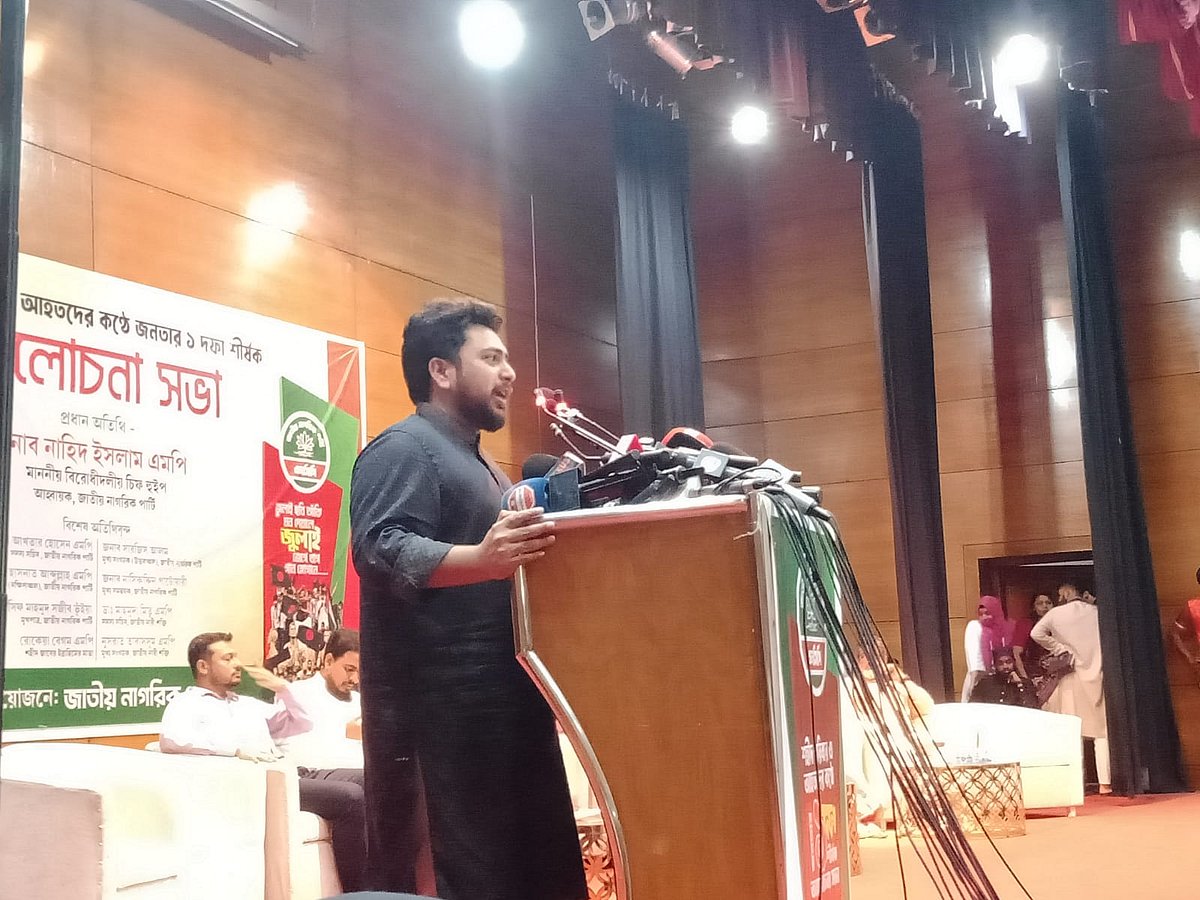
Mohammad Nahid Islam, convener of the National Citizen Party (NCP) and opposition Chief Whip, has declared that if Prime Minister Sheikh Hasina, who fled the country after being ousted in the July mass uprising, returns in December, she will be taken directly from the airport to the gallows. Islam stated this during a discussion meeting titled 'Public's 1 Point in the Voices of Martyr Families and the Injured,' organized by the NCP. He emphasized that the July uprising's 'one point' was not just Hasina's fall but the abolition of a fascist system and the establishment of a new political order, a goal he claims remains unfulfilled after two years. Islam argued that the partial implementation of this objective has left state reform, justice, and accountability incomplete, leading to continued politicization, corruption, and extortion in various sectors. He criticized the current government for failing to deliver on justice and reform, noting that trials for the July massacre, enforced disappearances, and killings have stalled, and healthcare benefits for the injured are ineffective. The NCP convener reiterated the demand for a new democratic constitution, warning of renewed protests if reform initiatives are hindered. He urged the government to announce a roadmap for the trial of the July massacre and necessary reforms, or face intensified protests. He also asserted that the martyrs of the July movement sacrificed for a non-discriminatory, democratic, and accountable state, not to bring any specific individual or party to power. NCP Member Secretary and Member of Parliament Akhtar Hossain echoed these sentiments, stressing unity on the spirit of the July movement and the martyrs' aspirations. He called for accountability for past human rights violations and oppression. Other speakers, including Sarjis Alam, NCP's chief organizer for the northern region, criticized attempts to politically manipulate the list of injured fighters. Roqueya Begum, mother of martyr Jaber Ibrahim and a reserved seat MP, highlighted the lack of progress in trials for past killings and enforced disappearances, warning of recurring violence if impunity persists. Mahmuda Alam Mitu, chief organizer of National Women's Power and a reserved seat MP, underscored the need for state reform initiatives to achieve a welfare-oriented and non-discriminatory state, reflecting the aspirations of those who died or were injured.
The opposition's rhetoric, particularly the call for immediate execution upon the Prime Minister's return, represents a highly charged political stance. This extreme language, while intended to mobilize supporters and signal unwavering resolve, risks overshadowing substantive policy demands like judicial reform and accountability for past events. Such pronouncements can escalate political tensions and potentially undermine the rule of law by advocating extra-judicial outcomes. From a systemic perspective, the focus on punitive measures rather than institutional reform may indicate a challenge in translating popular grievances into durable governance improvements. The long-term viability of democratic transition hinges on establishing robust legal frameworks and impartial justice mechanisms, rather than relying on revolutionary fervor or retribution, which can prove destabilizing in the subsequent governance phase.
AI-generated to prompt reflection — not editorial opinion, not advice, not a statement of fact. How this works.
