Orbital Disco Ball Provides Most Precise Test of Einstein's Theory of Relativity
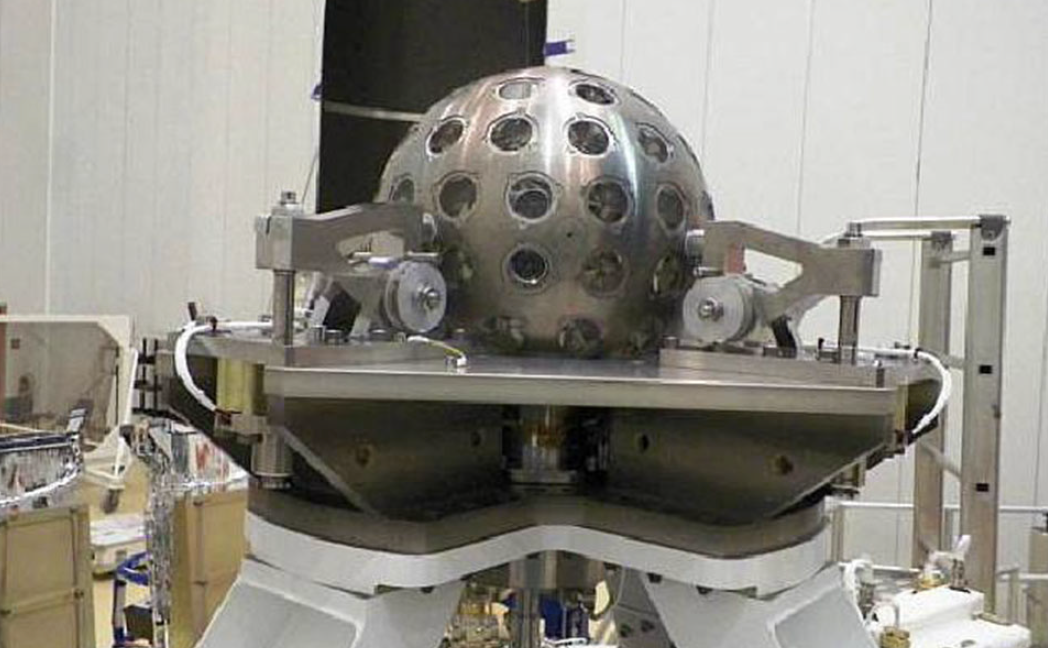
A unique experiment involving a "disco ball" orbiting Earth has yielded the most precise test to date of Albert Einstein's theory of general relativity. The experiment utilized a precisely controlled satellite, effectively acting as a "disco ball" in space, to measure the subtle distortions in space-time caused by Earth's mass. These distortions, predicted by Einstein's groundbreaking theory, affect the path and timing of objects moving through space-time. By meticulously tracking the satellite's trajectory and the signals it emitted, scientists were able to compare real-world observations with the predictions of general relativity. The results of this experiment have confirmed the theory with unprecedented accuracy. This validation is significant for our understanding of gravity and the fundamental structure of the universe. The findings reinforce the robustness of Einstein's framework, which has long been a cornerstone of modern physics, and open avenues for further exploration into the cosmos.
This experiment leverages advanced satellite technology to rigorously test a foundational theory of physics. By employing a precisely controlled orbiting object, scientists have achieved a new benchmark in verifying Einstein's predictions about space-time curvature. The success of this test underscores the enduring predictive power of general relativity, even as future technological advancements may necessitate further refinement or expansion of our gravitational models. Examining such precise measurements allows for a deeper understanding of the universe's mechanics and provides a robust empirical basis for future theoretical developments in cosmology and astrophysics.
AI-generated to prompt reflection — not editorial opinion, not advice, not a statement of fact. How this works.