Pakistan and Kyrgyzstan Vow to Deepen Trade and Strategic Partnership
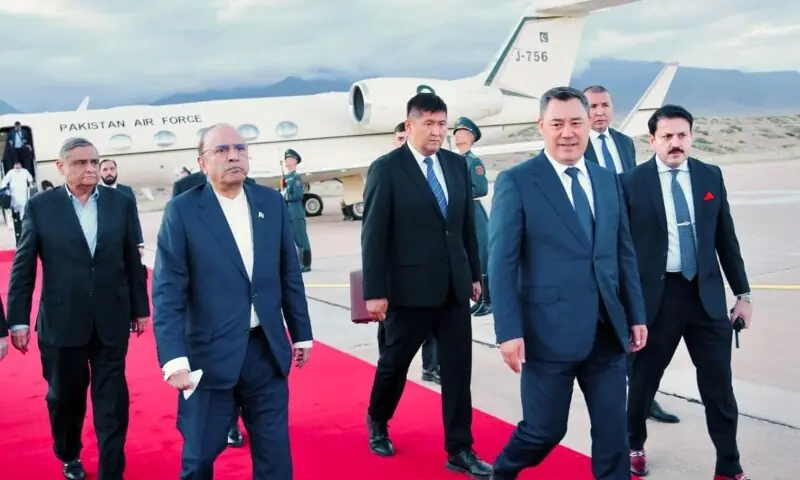
Pakistan's President Asif Ali Zardari and Kyrgyzstan's President Sadyr Zhaparov met on Tuesday, July 9th, during President Zardari's four-day official visit to Kyrgyzstan, reaffirming their commitment to enhancing bilateral relations. The leaders expressed satisfaction with the current state of Kyrgyz-Pakistani relations and emphasized the need for consistent implementation of agreements made during President Zhaparov's December visit to Pakistan. They stressed the importance of maintaining active political dialogue, increasing high-level contacts, and strengthening parliamentary and governmental interactions.
Both nations expressed readiness to establish a "strategic partnership," with a particular focus on deepening trade, economic, and investment cooperation. Ministers and agencies were directed to intensify joint efforts to implement existing agreements and take practical steps to develop trade, investment, and business ties. They also highlighted the need to improve inter-agency cooperation mechanisms and the effectiveness of the Kyrgyz-Pakistani Intergovernmental Commission on Trade, Economic, Scientific and Technical Cooperation. The leaders pledged comprehensive support for business communities in both countries, encouraging joint projects and ventures.
Discussions covered significant potential for cooperation in the energy sector, specifically the CASA-1000 Project, and explored opportunities in mining, agriculture, textiles, light industries, the halal industry, healthcare, pharmaceuticals, the digital economy, ICT, tourism, and the banking sector. Improving transport connectivity between Central and South Asia, including the utilization of Pakistan's seaports and Kyrgyzstan's transit potential, was also a key topic. The leaders agreed on the necessity of a secure environment for realizing the cooperation potential between Central and South Asia.
Furthermore, cooperation in education, science, culture, youth exchanges, and public health was discussed, with a focus on medical education quality assurance and regulatory collaboration. Both presidents also addressed strengthening cooperation in combating terrorism, extremism, drug trafficking, organized crime, cybercrime, and irregular migration, condemning terrorist attacks and pledging to work together on international forums. They committed to coordinating efforts within organizations like the UN, SCO, OIC, and ECO, with Pakistan expressing support for Kyrgyzstan's SCO chairmanship priorities and Kyrgyzstan thanking Pakistan for its support in its UNSC non-permanent member bid and its mediation role in the US-Iran MoU.
Pakistan expressed support for Kyrgyzstan's "Second Global Mountain Summit Bishkek+25" in 2027, and Kyrgyzstan invited Pakistan to the VI World Nomad Games from August 31 to September 7, an invitation Pakistan accepted. The visit concluded with both leaders expressing hope for further strengthening relations, expanding cooperation, and promoting the prosperity of their peoples. President Zardari extended an invitation to President Zhaparov to visit Pakistan, which was accepted.
This high-level meeting between Pakistan and Kyrgyzstan signifies a strategic pivot towards strengthening economic and security ties, moving beyond traditional diplomatic exchanges. The emphasis on a "strategic partnership" and concrete measures like revitalizing intergovernmental commissions and supporting business communities suggests a deliberate effort to unlock untapped economic potential, particularly through regional connectivity projects like CASA-1000. The joint commitment to combating shared security threats, from terrorism to cybercrime, reflects a pragmatic response to evolving regional challenges. Looking ahead, the success of these initiatives will hinge on sustained political will, effective implementation of agreements, and the ability of both nations to navigate complex geopolitical dynamics and foster a stable environment conducive to investment and trade. The discussions also highlight a growing recognition of the interconnectedness of Central and South Asia, with potential for these bilateral agreements to serve as a model for broader regional integration.
AI-generated to prompt reflection — not editorial opinion, not advice, not a statement of fact. How this works.