Pakistan Floods: Girls' Education Disrupted, Recovery Efforts Fall Short
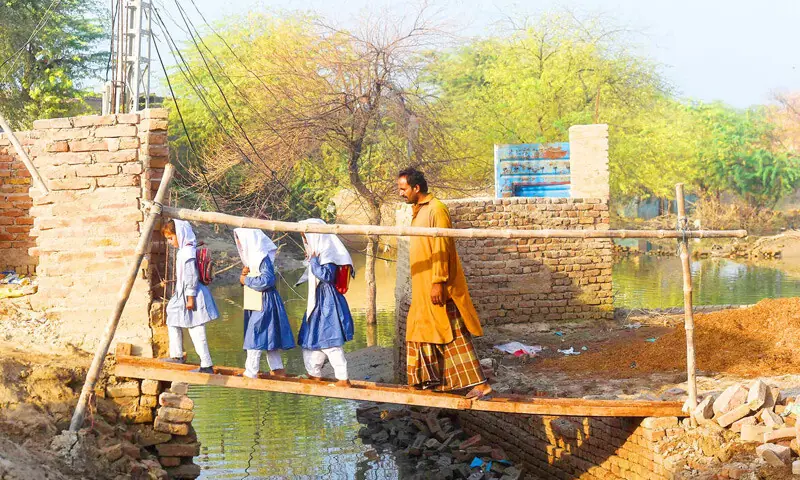
Persistent flooding in Pakistan's Sindh province, with major events in 2011, 2022, and 2024, has severely disrupted girls' education, leading to permanent dropouts. Khanzadi Kapri, founder of Aurat Sujag, highlights that while schools may be rebuilt on paper with new flags and assigned teachers, they often lack essential infrastructure like roofs and consistently present educators. This leads to hundreds, if not thousands, of girls completing primary education but never enrolling in secondary school. The 2022 monsoon floods, the worst on record, submerged one-third of Pakistan, devastating Sindh. While international donors pledged funds and temporary learning centers were established, many schools remain unrepaired. As of early 2026, over 14,000 schools in Sindh are still awaiting reconstruction. Pakistan's education spending has hit a record low of approximately 0.8 percent of GDP for fiscal year 2024-2025, far below UNESCO's benchmark, with minimal funds allocated for flood-damaged school restoration. In Sindh, 7.4 million children, or 44 percent of the 5-16 age group, are out of school, with girls disproportionately affected due to structural and socio-cultural barriers. Grassroots initiatives like TaleemDaan and Aurat Sujag observe that enrollment figures often mask low actual attendance and learning outcomes. Boys are also affected, often pulled out for agricultural labor or migration, but girls face compounded challenges including safety, mobility, and early marriage. The recovery narrative, driven by donor and government demands for visible results, often relies on inflated enrollment numbers and the superficial rebuilding of schools, failing to capture the reality of absent teachers, damaged facilities, and the silent dropout of girls.
The recurring floods in Pakistan's Sindh province expose a critical disconnect between disaster recovery metrics and the lived reality of educational access for girls. Post-disaster funding cycles incentivize the appearance of progress, leading to the superficial reconstruction of schools and inflated enrollment figures that mask ongoing systemic failures. This focus on quantifiable outputs, such as rebuilt structures and reported attendance, neglects the qualitative aspects of education, including consistent teaching, adequate facilities, and the socio-cultural barriers that disproportionately affect girls' continued schooling. The low national education spending, exacerbated by insufficient allocation for flood-damaged infrastructure, suggests a broader governance challenge in prioritizing long-term educational resilience. The data presented indicates that while floods act as a catalyst, the underlying issues of educational inequality and underfunding predate the disasters, creating a vulnerability that climate-related events exploit. Future interventions must move beyond mere reconstruction to address the root causes of educational disparity and ensure that recovery efforts genuinely support sustained learning for all children, particularly girls.
AI-generated to prompt reflection — not editorial opinion, not advice, not a statement of fact. How this works.