Pakistan FM Highlights Global Stability Threats at ASEAN Regional Forum
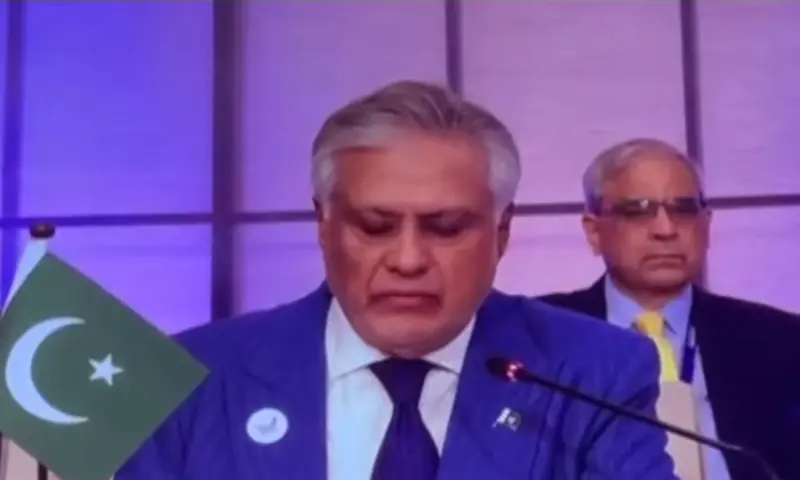
At the ASEAN Regional Forum (ARF) in Manila, Philippines, on Thursday, Pakistan's Deputy Prime Minister and Foreign Minister Ishaq Dar identified eight key challenges jeopardizing global peace and stability. He emphasized that delays in addressing these issues undermine collective efforts for regional and international prosperity. Dar specifically pointed to the Jammu and Kashmir dispute as a primary source of regional instability, advocating for a UN-backed resolution aligned with Kashmiri aspirations. He also voiced concern over India's unilateral suspension of the Indus Water Treaty, urging international support for a peaceful settlement to this long-standing water dispute between the two nuclear-armed nations.
Minister Dar also discussed Pakistan's role in facilitating dialogue between the United States and Iran, highlighting the opportunity for lasting peace and the potential reopening of the Strait of Hormuz. He drew attention to the humanitarian crisis in Gaza, questioning the international community's collective conscience and reiterating support for an independent Palestinian state. Furthermore, Dar addressed terrorism as a common threat, detailing Pakistan's significant sacrifices and losses, and urged the Afghan Taliban regime to prevent the use of Afghan territory for attacks against Pakistan, citing the Tehreek-i-Taliban Pakistan (TTP) and the Balochistan Liberation Army (BLA) as groups operating from there.
Additional concerns raised included the Ukraine-Russia war, for which Pakistan supports diplomatic solutions, and tensions in the South China Sea, where Pakistan advocates for non-interference and restraint. Dar reaffirmed Pakistan's commitment to the One-China principle. Finally, he highlighted climate change as a critical global challenge, noting Pakistan's vulnerability despite low emissions, and called for enhanced international cooperation and a strengthened preventive diplomacy role for the ARF. He welcomed the Manila Plan of Action 2026-2036 and pledged Pakistan's commitment to its implementation. On the sidelines, Dar held bilateral meetings with foreign ministers from Oman, New Zealand, Australia, the UK, Russia, Bangladesh, Sri Lanka, and met with ASEAN Secretary-General Dr Kao Kim Hourn, EU's Kaja Kallas, and visited the Asian Development Bank.
Deputy Prime Minister Dar's address at the ARF highlights a complex geopolitical landscape where regional disputes and global conflicts intersect. The framing of the Jammu and Kashmir issue and the Indus Water Treaty as central to regional stability reflects Pakistan's long-standing foreign policy priorities. By positioning Pakistan as a facilitator in US-Iran relations, the government seeks to enhance its diplomatic standing and leverage. The emphasis on terrorism, particularly concerning groups operating from Afghan soil, underscores the persistent security challenges stemming from regional instability and governance vacuums. The inclusion of the Ukraine war and South China Sea tensions indicates an effort to align Pakistan's diplomatic narrative with broader international concerns, while reaffirming adherence to established principles like the One-China policy. The call for climate action and strengthened preventive diplomacy suggests a forward-looking agenda, acknowledging global systemic risks. The overall discourse aims to project Pakistan as a responsible actor addressing multifaceted threats, while simultaneously advocating for its core national interests and seeking international support for its positions on key disputes.
AI-generated to prompt reflection — not editorial opinion, not advice, not a statement of fact. How this works.