Pakistan, Iran Discuss Regional Stability Amid Escalating US-Iran Tensions
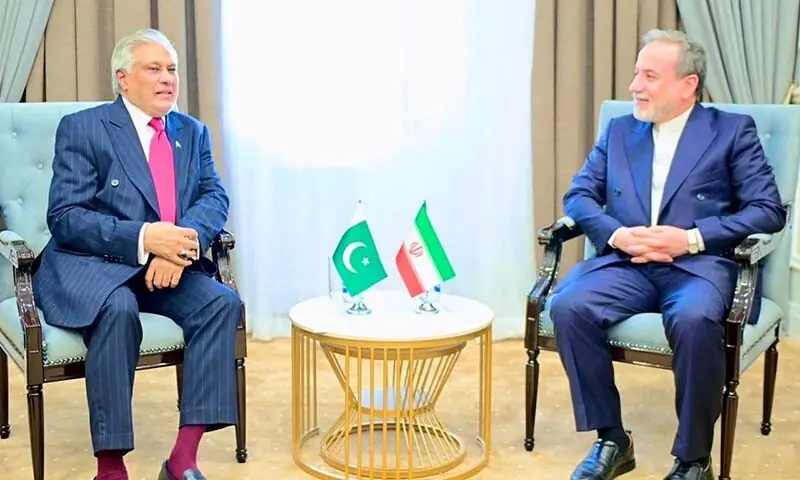
Deputy Prime Minister and Foreign Minister Ishaq Dar met with Iranian Foreign Minister Abbas Araghchi on Friday in Cholpon-Ata, Kyrgyzstan, on the sidelines of the Shanghai Cooperation Organisation’s Council of Foreign Ministers Meeting. The discussion focused on the current regional situation and bilateral relations, particularly emphasizing the need to uphold commitments made in the Islamabad Memorandum of Understanding (MoU). This meeting occurred amidst heightened tensions between the United States and Iran, following recent military exchanges. Dar expressed significant concern over the escalating regional conflict, advocating for dialogue, restraint, de-escalation, and sustained diplomatic engagement to ensure lasting peace and stability. He specifically highlighted the importance of building upon the understandings reached in the Islamabad MoU, signed in June 2026.
Araghchi acknowledged Pakistan's ongoing diplomatic support for regional peace and security, thanking Islamabad for its role in facilitating the safe return of Iranian fishermen and sailors. Both ministers agreed to maintain close coordination and regular consultations on matters of mutual interest, reaffirming their commitment to collaborative efforts for regional peace, stability, and shared prosperity. The recent escalation, including US airstrikes on Iranian military facilities and Iranian responses targeting US bases, has cast uncertainty over the future of the MoU, which aims to reopen the Strait of Hormuz and end a protracted conflict. The US Central Command stated its strikes targeted Iranian command centers, drone facilities, and communication networks to mitigate threats to maritime traffic in the Strait of Hormuz, a vital waterway experiencing ongoing conflict.
The diplomatic engagement between Pakistan and Iran, occurring amidst significant US-Iran military escalations, highlights a strategic imperative for regional actors to navigate escalating geopolitical risks. The emphasis on the Islamabad MoU suggests a framework for de-escalation and stability that both nations seek to preserve, potentially as a buffer against wider conflict. The Pakistani delegation's call for dialogue and restraint, alongside Iran's acknowledgment of Pakistan's diplomatic efforts, underscores a shared interest in managing regional security dynamics. This interaction can be viewed through the lens of alliance structures and national security interests, where maintaining open channels of communication becomes critical when major global powers are in direct confrontation. The future effectiveness of such bilateral agreements will likely depend on the broader geopolitical climate and the willingness of all parties involved to prioritize diplomatic solutions over military confrontation, particularly concerning vital trade routes like the Strait of Hormuz.
AI-generated to prompt reflection — not editorial opinion, not advice, not a statement of fact. How this works.