Pakistan Military Vows to Pursue Balochistan Terrorists 'Everywhere'
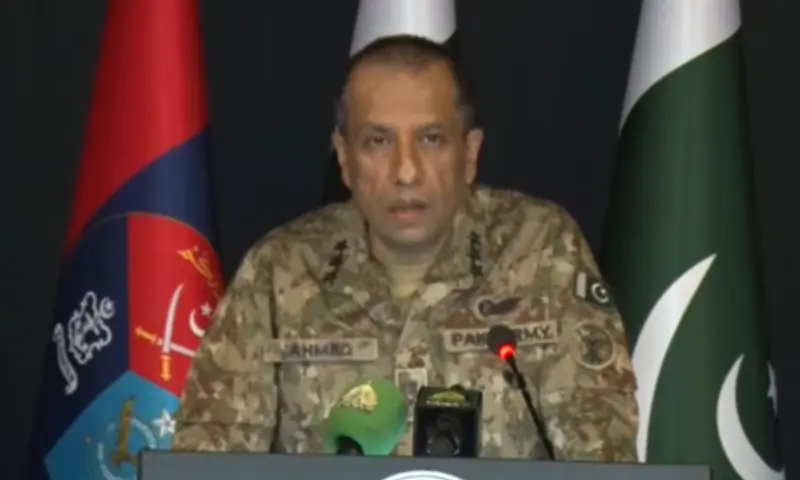
Director General of the Inter-Services Public Relations (ISPR), Lt Gen Ahmed Sharif Chaudhry, held a press conference to address escalating security concerns in Balochistan. He detailed three major terrorist incidents that occurred within a four-day period, beginning July 4th. The first incident involved "Fitna al Khawarij terrorists" attacking civilians in Hanna Urak, resulting in four civilian deaths and six injuries. The Pakistani government uses the term "Fitna al-Khawarij" to refer to the banned Tehreek-i-Taliban Pakistan (TTP) and its affiliates. In the second incident on July 6th, terrorists attacked a police checkpost guarding a dam in Ziarat, leading to the martyrdom of nine policemen and the capture of remaining officers as hostages. The military and Frontier Corps responded, but due to the hostage situation, aerial assets were not used to avoid collateral damage. The third and ongoing incident in the Ziarat mountains involved continued engagement with terrorists, resulting in the martyrdom of 18 more policemen, bringing the total police casualties to 27. Lt Gen Chaudhry stated that 26 terrorists have been killed in these operations so far, with 11 killed during the ongoing Ziarat operation.
The ISPR's briefing frames recent violence in Balochistan through a narrative of external proxy involvement and determined Pakistani defense. By labeling the perpetrators as "Fitna al Khawarij" and an "Indian proxy," the discourse aims to consolidate national unity against a perceived external threat, potentially deflecting from internal governance or ethnic grievances that may fuel instability. The emphasis on military successes, such as the number of terrorists neutralized, serves to project state control and resolve. However, this framing may overlook the complex socio-economic and political dynamics within Balochistan that contribute to the security situation. Future stability may depend on addressing these underlying issues alongside counter-terrorism efforts, fostering a more inclusive approach that moves beyond a purely security-centric paradigm.
AI-generated to prompt reflection — not editorial opinion, not advice, not a statement of fact. How this works.