Pakistan Reaffirms GSP+ Commitments to EU Delegation
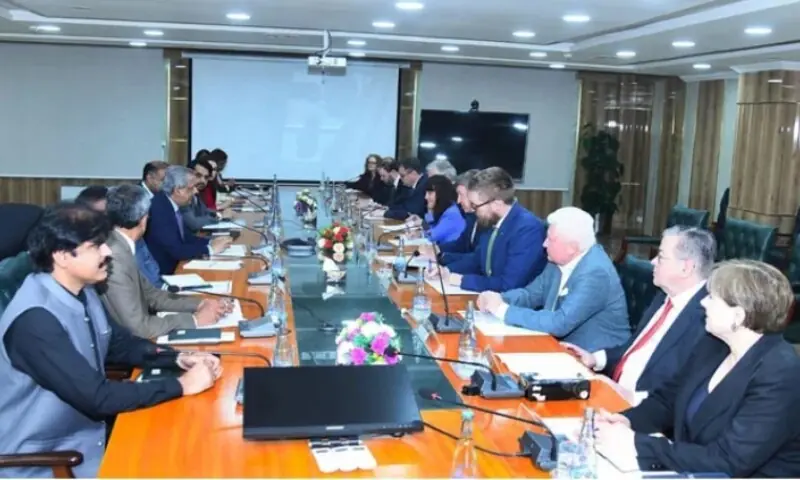
Federal Minister for Law and Human Rights Azam Nazeer Tarar met with a European Union delegation and ambassadors from EU member states in Islamabad on Thursday, July 10th, 2026. The meeting, led by EU Ambassador to Pakistan Raimundas Karoblis, focused on Pakistan's obligations under the EU's GSP+ framework and the advancement of human rights. Discussions covered Pakistan-EU relations, the GSP+ program, human rights, the rule of law, and areas for mutual cooperation. The delegation included ambassadors from Sweden, Norway, France, the Netherlands, and the Czech Republic, along with representatives from Ireland and Canada. Both sides reviewed Pakistan's progress on human rights commitments and stressed the importance of ongoing engagement to strengthen the partnership. The diplomats acknowledged Pakistan's recent human rights initiatives, such as the National Commission for Minorities and the Protection of Journalists and Media Professionals Act. They also discussed the death penalty moratorium and broader human rights obligations. Minister Tarar detailed ongoing legal and institutional reforms designed to protect fundamental rights, improve justice access, and reinforce the rule of law. He emphasized the government's dedication to safeguarding human rights while strictly adhering to constitutional and legal frameworks for counterterrorism measures. The minister assured the EU of Pakistan's continued constructive engagement on human rights, legal reforms, and GSP+ commitments. The meeting concluded with mutual satisfaction and a commitment to deepen cooperation and maintain regular dialogue.
This engagement highlights Pakistan's strategic imperative to maintain its preferential trade status under the EU's GSP+ scheme, which is contingent on adherence to international conventions on human rights and labor. The Pakistani government's emphasis on legal and institutional reforms, alongside counterterrorism measures, reflects a balancing act between domestic security priorities and international trade obligations. The EU delegation's acknowledgment of specific reforms, such as the Journalists' Protection Act, suggests a focus on tangible progress in key areas. Moving forward, the sustainability of this partnership will likely depend on Pakistan's consistent implementation of these reforms and its ability to demonstrate measurable improvements in human rights, particularly concerning minority rights and the application of the death penalty, which remain sensitive points of international scrutiny. The dynamic between domestic governance and external trade incentives will continue to shape Pakistan's policy decisions in the coming decade.
AI-generated to prompt reflection — not editorial opinion, not advice, not a statement of fact. How this works.