Pakistan Rejects India's Indus Water Treaty Stance at UN, Cites 'Illegal' Abeyance
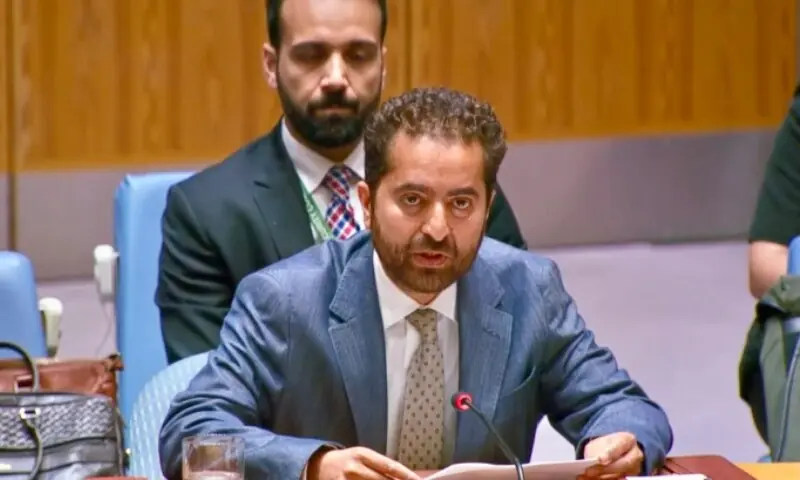
Pakistan has strongly refuted India's position on the Indus Water Treaty (IWT) during a United Nations Security Council (UNSC) debate on natural resource governance. Pakistan's Permanent Representative to the UN, Asim Iftikhar Ahmad, criticized India's unilateral decision to place the treaty in abeyance following the Pulwama attack, deeming it an illegal act and an abuse of shared water resources for political coercion. He emphasized that no treaty provisions allow for such an abeyance, and that the Permanent Court of Arbitration (PCA) reaffirmed the treaty's validity in August 2025. Ahmad stated that India's actions threaten the livelihoods of over 240 million Pakistanis and pose a risk to regional and international peace. He also dismissed India's accusations of state-sponsored terrorism, instead accusing India of sponsoring terrorism against Pakistan through proxy groups like the Tehreek-i-Taliban Pakistan and the Balochistan Liberation Army. Furthermore, Ahmad highlighted India's alleged extraterritorial executions and state terrorism in occupied Kashmir, asserting that the territory's disputed status cannot be altered by unilateral measures. He urged the UNSC to remain vigilant against the weaponization of natural resources and to utilize its tools to address such threats. India's Ambassador Harish Parvathaneni had previously accused Pakistan of terrorism, which he claimed eroded the basis for bilateral cooperation on the treaty, and asserted India's claim over occupied Kashmir.
This exchange at the UNSC highlights the deep-seated geopolitical tensions between India and Pakistan, framing resource management, specifically water, as a critical element of their ongoing dispute. Pakistan's invocation of international law and treaty obligations underscores its strategy to legitimize its claims on the global stage, while India's counter-accusations of terrorism serve to frame Pakistan as a destabilizing actor. The weaponization of shared resources, such as water, by upper riparian states presents a recurring challenge in international relations, particularly in regions with high population density and water scarcity. Future governance frameworks for transboundary water resources will need to balance national sovereignty with equitable access and dispute resolution mechanisms that are perceived as impartial and effective, especially as climate change intensifies water stress.
AI-generated to prompt reflection — not editorial opinion, not advice, not a statement of fact. How this works.