Pakistan's Agriculture Tax Reform Falls Short of Revenue Goals
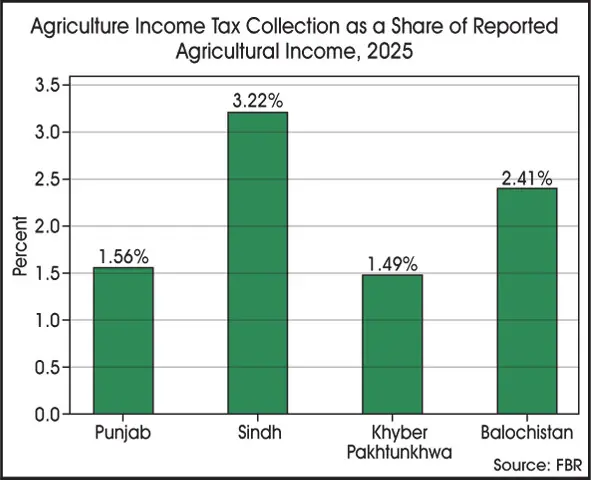
Pakistan's unified agriculture income tax regime, introduced last year as part of an International Monetary Fund-backed fiscal restructuring program, has shown a significant gap between its ambitious policy goals and actual revenue collection. In fiscal year 2025-26, provincial tax authorities collected only about 2% of the agricultural income declared by taxpayers. Approximately 445,000 taxpayers declared Rs306 billion in agricultural income for tax year 2025, but only Rs5.62 billion was collected in agriculture income tax (AIT) across all four provinces. Structural weaknesses, insufficient enforcement, political considerations, and the influence of large landowners are identified as key reasons for this underperformance. Each province has adopted a different implementation strategy, with Sindh aligning its super tax with the federal regime, while Punjab and Khyber Pakhtunkhwa have taken different approaches regarding advance and super taxes. Balochistan has yet to reveal its AIT policy for the upcoming fiscal year. Experts suggest that taxing agricultural income is a deeply entrenched political issue, with provincial governments often influenced by landed elites, making effective taxation a challenge to the ruling coalitions. The situation highlights a deficit in state capacity, where provinces lack the administrative machinery and political autonomy to confront powerful rural constituencies. Punjab, despite having the largest share of declared agricultural income, collected tax equivalent to only 1.56% of that income, while Sindh had the highest collection ratio at 3.22%. The weak collection ratios underscore the significant untapped revenue potential within the agriculture sector, especially as provinces face increasing pressure to mobilize their own resources through direct taxes. Challenges such as weak land records, fluctuating farm incomes, and the political influence of large landowners are expected to persist, though economists suggest systems could be designed to protect small farmers while ensuring larger commercial farmers and absentee landowners contribute fairly. In Punjab, despite missing its original AIT target by a wide margin, the province has set a higher collection target for the next fiscal year, indicating a push for stronger enforcement. Reforms in Sindh, including assigning AIT administration to the Sindh Revenue Board, have not yet overcome weak tax compliance.
The implementation of Pakistan's unified agriculture income tax regime reveals a persistent challenge in aligning fiscal policy with on-the-ground revenue collection, particularly in a sector with significant political and economic influence. The stark discrepancy between declared income and collected tax suggests that systemic issues, including administrative capacity deficits and the entrenched power of large landowners, continue to impede the state's ability to broaden the tax base. While international financial institutions may push for reforms, their success hinges on the political will and institutional strength within provinces to overcome deeply rooted structural obstacles. Looking ahead, the effectiveness of such reforms will likely depend on innovative approaches that can balance revenue generation with the complexities of agricultural economies and rural power dynamics, potentially through more targeted tax structures or enhanced transparency mechanisms. The next decade may see increased pressure on provincial governments to generate domestic revenue, making the resolution of these long-standing issues critical for fiscal stability and equitable development.
AI-generated to prompt reflection — not editorial opinion, not advice, not a statement of fact. How this works.