Pakistan's CPEC 2.0 Pivots to Market-Driven Growth, Faces Internal and Geopolitical Hurdles
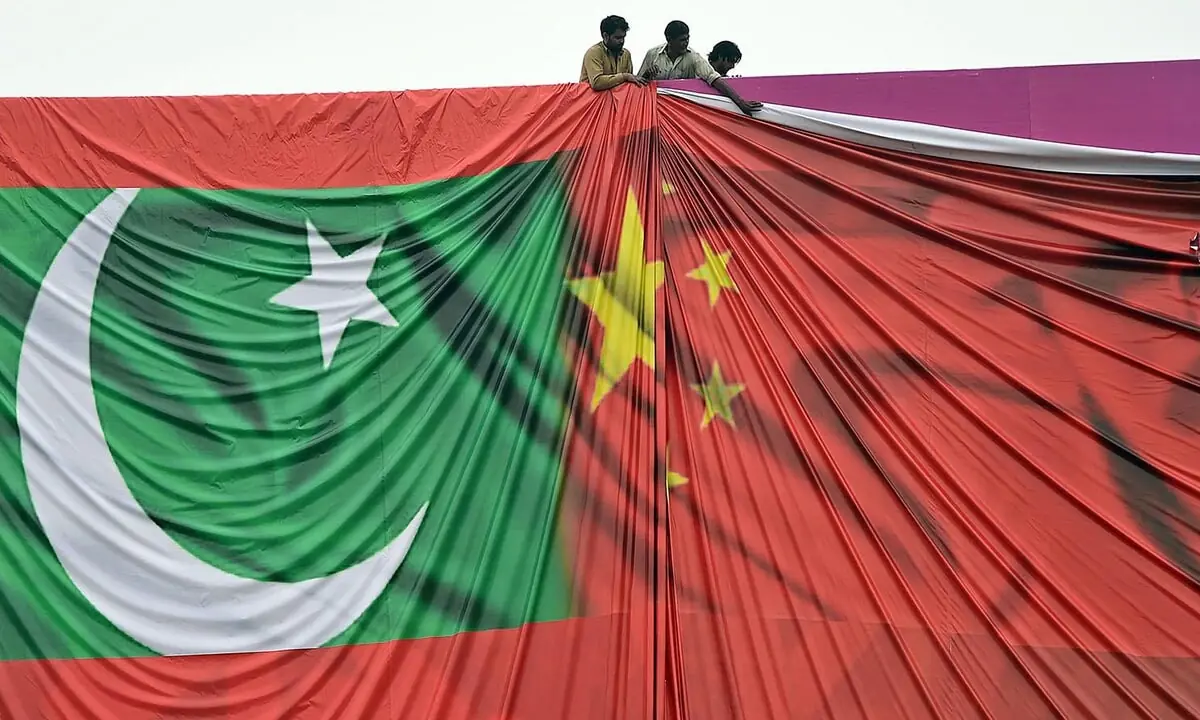
China and Pakistan are transitioning the China-Pakistan Economic Corridor (CPEC) from its initial infrastructure-focused phase (CPEC 1.0) to a more market-driven and technologically integrated framework, termed CPEC 2.0. The first phase, valued at approximately $62 billion with over $25 billion in completed Chinese investments, focused on critical infrastructure, adding over 8,000 megawatts to Pakistan's power grid. However, this also led to repayment pressures and an underutilized industrial base. CPEC 2.0 aims to shift towards business-to-business cooperation and private sector integration, merging Pakistan's "5Es" policy (exports, e-Pakistan, environment, energy, equity) with China's "Five Corridors" (growth, innovation, green, livelihood, openness). The goal is to transform Pakistan into an export-driven economy, with bilateral trade reaching $25.23 billion. An upgraded Free Trade Agreement targets joint ventures in AI, biotechnology, and technology parks to boost Pakistan's IT exports, which already exceed $3 billion annually.
Despite these ambitions, CPEC 2.0 faces significant internal challenges within Pakistan, including macroeconomic instability, institutional delays, bureaucratic red tape, and political uncertainty that disrupts policy continuity. Security concerns for Chinese nationals and projects, stemming from militancy and insurgencies, have caused project interruptions and cost overruns. Beijing emphasizes that sustainable economic integration requires a stable security environment. Furthermore, CPEC 2.0 must navigate a complex geopolitical landscape. China is cautious about Pakistan's growing ties with Western nations, including the US, while India strongly opposes CPEC, particularly routes through disputed Kashmir territory, viewing it as an expansion of China's geopolitical influence. For CPEC 2.0 to succeed, Pakistan must address these internal vulnerabilities through transparent resource management, equitable benefit distribution, institutional stability, and a secure environment, converting physical connectivity into sustainable economic competitiveness.
The evolution of CPEC into its second phase signifies a strategic recalibration by both Beijing and Islamabad, shifting from state-led infrastructure to market-driven economic integration. This pivot reflects a broader global trend towards deeper technological and private sector collaboration. However, the success of CPEC 2.0 is critically contingent on Pakistan's internal capacity to manage macroeconomic volatility, strengthen institutional governance, and ensure security. These domestic factors present significant execution risks, potentially limiting the project's ability to generate sustainable economic dividends. Externally, CPEC 2.0's trajectory will be influenced by evolving geopolitical alignments, particularly Pakistan's relations with Western powers and India's persistent opposition, which could constrain regional integration and investment flows. The initiative's long-term viability hinges on Pakistan's ability to create a stable and predictable environment that can attract and sustain private sector engagement, thereby transforming physical infrastructure into genuine economic competitiveness.
AI-generated to prompt reflection — not editorial opinion, not advice, not a statement of fact. How this works.