Pakistan's Foreign Minister and PPP Chairman Discuss Kashmir and Upcoming Elections
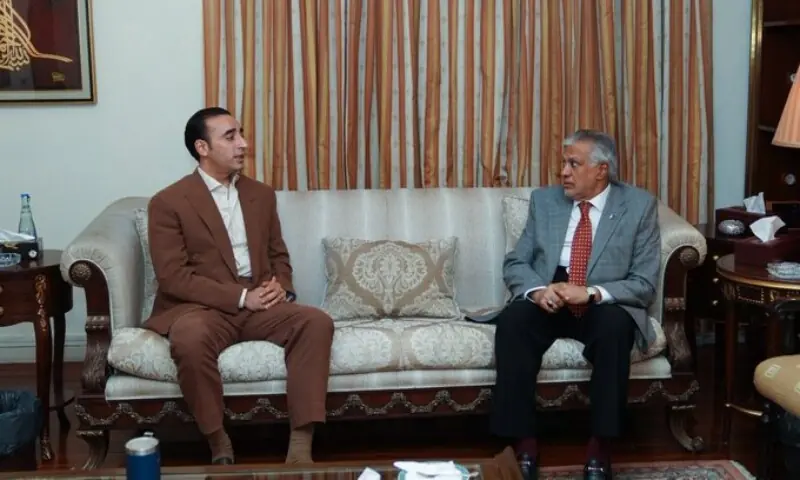
Pakistan's Deputy Prime Minister and Foreign Minister Ishaq Dar met with Pakistan Peoples Party (PPP) Chairman Bilawal Bhutto-Zardari on Tuesday at the Aiwan-i-Sadr. The leaders engaged in discussions concerning the "overall situation in the country, including matters relating to Azad Jammu and Kashmir (AJK)". This meeting precedes the general elections slated for AJK on July 27. Earlier in June, Bilawal and Jamiat Ulema-i-Islam (JUI-F) chief Maulana Fazlur Rehman had declared their parties' intention to jointly participate in the AJK elections. Concurrently, the proscribed Joint Awami Action Committee (JAAC) has announced plans for extensive protests, advocating for the elimination of 12 designated reserved seats. This follows a previous meeting between Bilawal and Dar last week, which also focused on the "situation in AJK and Gilgit-Baltistan," as reported by Radio Pakistan. Both political figures affirmed the necessity of conducting free, fair, and transparent elections in AJK. Notably, the PPP established a government in Gilgit-Baltistan (GB) last month with the backing of the PML-N, a political alignment that mirrors the federal government's structure.
This high-level meeting between key political figures addresses electoral preparations and regional stability in Pakistan-administered territories. The focus on upcoming AJK elections, coupled with discussions on broader national issues, highlights the interconnectedness of domestic politics and territorial claims. The involvement of multiple political parties and the planned protests by the JAAC indicate a complex political landscape with diverse stakeholder interests. The emphasis on free and fair elections suggests an awareness of international scrutiny and the importance of democratic processes for legitimacy. Future developments will likely be shaped by the electoral outcomes and the government's ability to manage competing demands and maintain stability in these sensitive regions.
AI-generated to prompt reflection — not editorial opinion, not advice, not a statement of fact. How this works.