Pakistani Clerics Unite for Joint Prayers, Promoting Religious Harmony
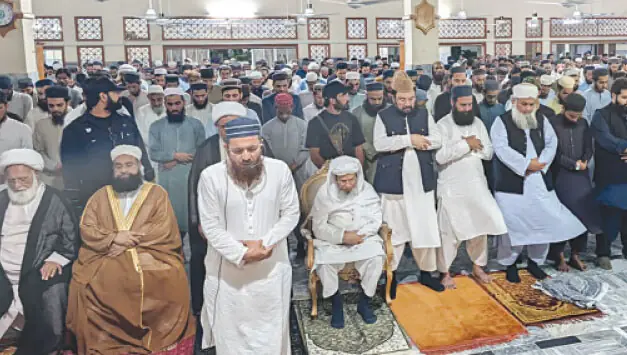
In a significant move towards fostering religious tolerance, clerics from Pakistan's four mainstream Islamic schools of thought—Shia, Barelvi, Deobandi, and Ahle Hadith—participated in joint prayers at Jamiatur Rasheed seminary in Karachi. This event, facilitated by the National Paigham-i-Aman Committee (NPAC), led by its chairman Hafiz Muhammad Tahir Ashrafi, is viewed as a crucial step in combating extremism and sectarian violence. Ashrafi, who also serves as the Prime Minister's Coordinator for the NPAC, stated that the collective prayer symbolizes increasing tolerance within society, particularly among religious leaders. The NPAC, established in September 2024, aims to counter extremism and promote unity, bringing together religious scholars and leaders from various faith communities. This initiative is part of a broader national campaign against terrorism and sectarianism, aligning with the objectives of Paigham-i-Pakistan. The committee has also engaged with leaders from Sikh, Hindu, and Christian communities. The NPAC operates under the National Committee on Narrative Building (NCNB), which coordinates national efforts against extremism through various media and communication channels, in line with the Revised National Action Plan 2021.
This event highlights a strategic effort by Pakistani authorities and religious leaders to counter sectarian divisions and promote a unified national narrative against extremism. By convening clerics from diverse Islamic schools of thought for joint prayers at a historically hardline seminary, the initiative aims to de-escalate inter-sect tensions and project an image of religious harmony. The involvement of the NPAC, a body linked to government and intelligence agencies, suggests a top-down approach to narrative control and social cohesion. While such efforts can foster goodwill and reduce immediate conflict, their long-term efficacy depends on addressing the underlying socio-economic and political factors that fuel extremism and sectarianism. The challenge lies in translating symbolic gestures into sustainable societal change that transcends institutional directives and fosters genuine grassroots tolerance and mutual respect.
AI-generated to prompt reflection — not editorial opinion, not advice, not a statement of fact. How this works.