Passenger Survives Miracle Escape After Being Partially Sucked From Ryanair Plane
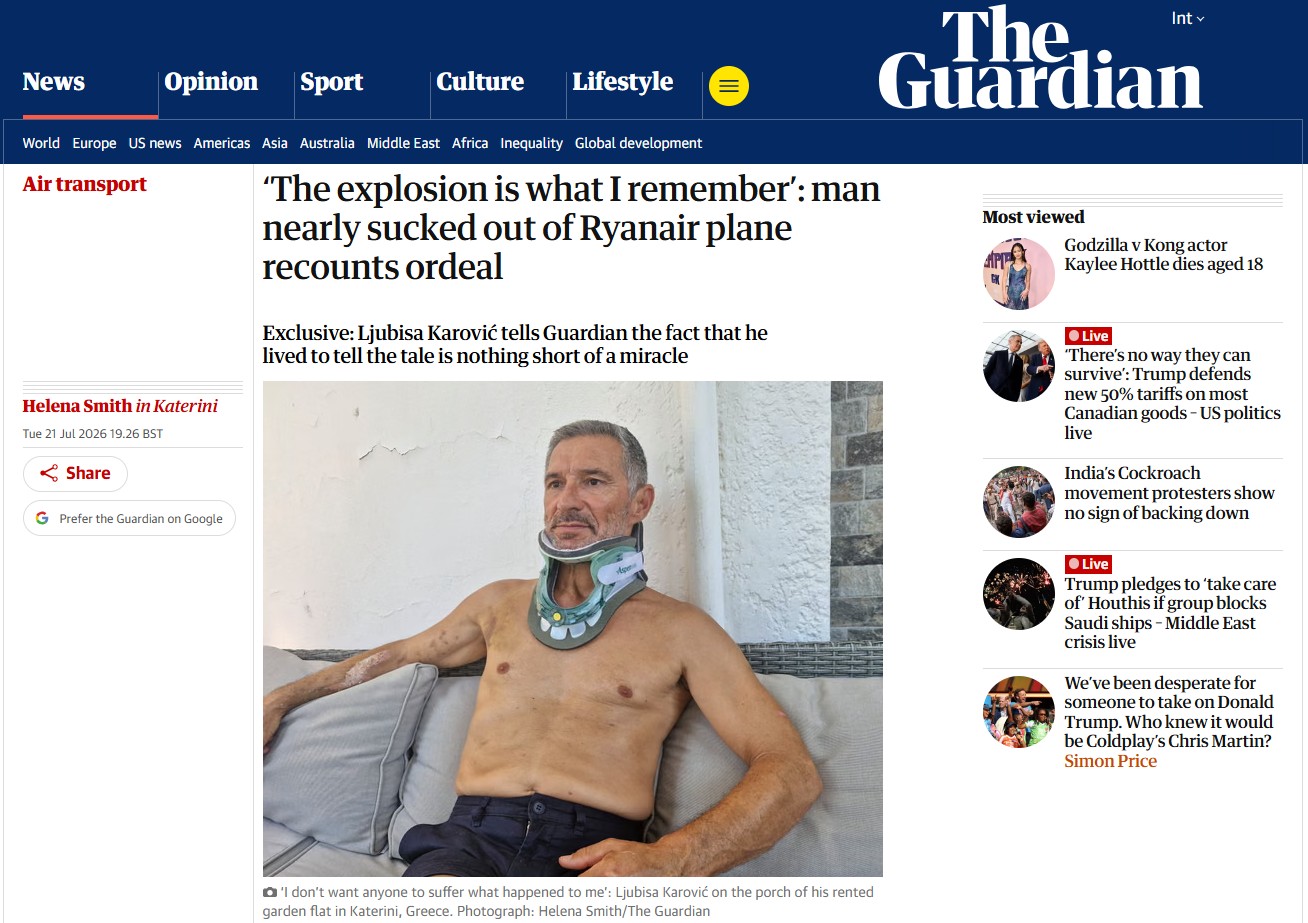
Ljubisa Karović, a 61-year-old Serbian man, described his survival as a miracle after being partially sucked out of a Ryanair airplane when a window broke during a flight from Greece to Germany on July 10. Karović recounted the terrifying experience, stating that the sound of the explosion is what he remembers most vividly and replays in his mind whenever he tries to sleep. The aircraft had to make an emergency landing back in Greece. Karović reported passing out multiple times, both outside the plane when he was pulled back in and inside during the descent. He was hospitalized and recently discharged, but still suffers from head and neck pain, requiring a cervical collar for at least six weeks as doctors assess the need for surgery. He also sustained burns and bruising on his right arm and expressed reluctance to fly again soon. Karović attributed his survival to his seatbelt and possibly fate, expressing gratitude to God. His lawyer, Vasilis Tsiaras, stated Karović was "between life and death" and criticized the crew for not offering assistance when he lost consciousness. Ryanair stated that in depressurization events, passengers and crew are required to use safety belts and oxygen masks, and that the crew provided assistance once the plane reached a safe altitude. A preliminary investigation by Ryanair CEO Michael O'Leary suggests the incident was caused by a "foreign object" hitting the engine during takeoff, potentially impacting the responsibility of Boeing and Ryanair.
This incident highlights critical safety considerations in commercial aviation, particularly concerning structural integrity and emergency response protocols. The preliminary finding of a foreign object strike during takeoff necessitates a thorough investigation into maintenance procedures, foreign object debris (FOD) management at airports, and the resilience of aircraft components like engines and fuselages to such impacts. The passenger's harrowing experience underscores the importance of robust cabin integrity and the psychological toll of near-fatal events. Future aviation safety frameworks may need to further integrate predictive maintenance, advanced material science for component durability, and refined crew training for extreme emergency scenarios to mitigate risks and ensure passenger well-being in the face of unforeseen airborne hazards.
AI-generated to prompt reflection — not editorial opinion, not advice, not a statement of fact. How this works.