Peking University Neuromorphic Chip Outperforms NVIDIA A100 in Brain Cortex Reconstruction
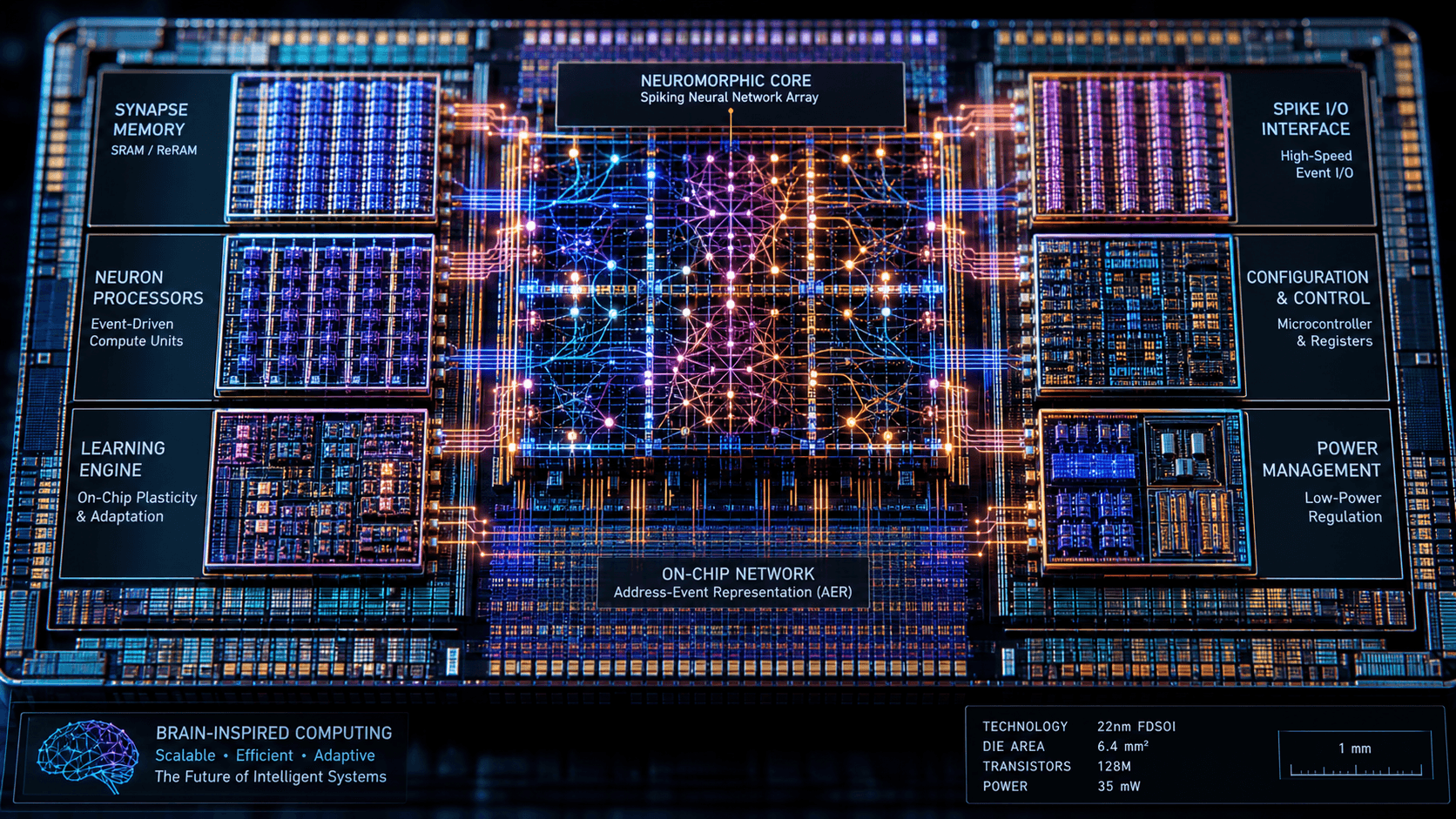
Researchers from Peking University and the Chinese Academy of Sciences (CAS) have developed a novel neuromorphic chip that demonstrates significantly faster processing speeds compared to existing high-performance GPUs. The chip, built on a 40nm phase-change memristor architecture, achieves a computation latency of just 2.12 milliseconds. In tests simulating brain cortex reconstruction, this new chip proved to be between 50 and 478 times faster than NVIDIA's A100 GPU. The groundbreaking findings were published in the prestigious scientific journal, Science.
This development highlights the rapid advancements in neuromorphic computing, which aims to mimic the structure and function of the human brain. The reported performance gains over established hardware like the NVIDIA A100 suggest a potential paradigm shift in specialized AI acceleration, particularly for tasks involving complex pattern recognition and simulation. The use of phase-change memristors points to the ongoing exploration of novel memory and processing technologies beyond traditional silicon-based architectures. Future research will likely focus on scaling these technologies, improving their energy efficiency, and integrating them into practical AI systems to address the growing computational demands of the AI era.
AI-generated to prompt reflection — not editorial opinion, not advice, not a statement of fact. How this works.