Peruvian Amazon River Boils at Nearly 100°C Without Volcanic Activity
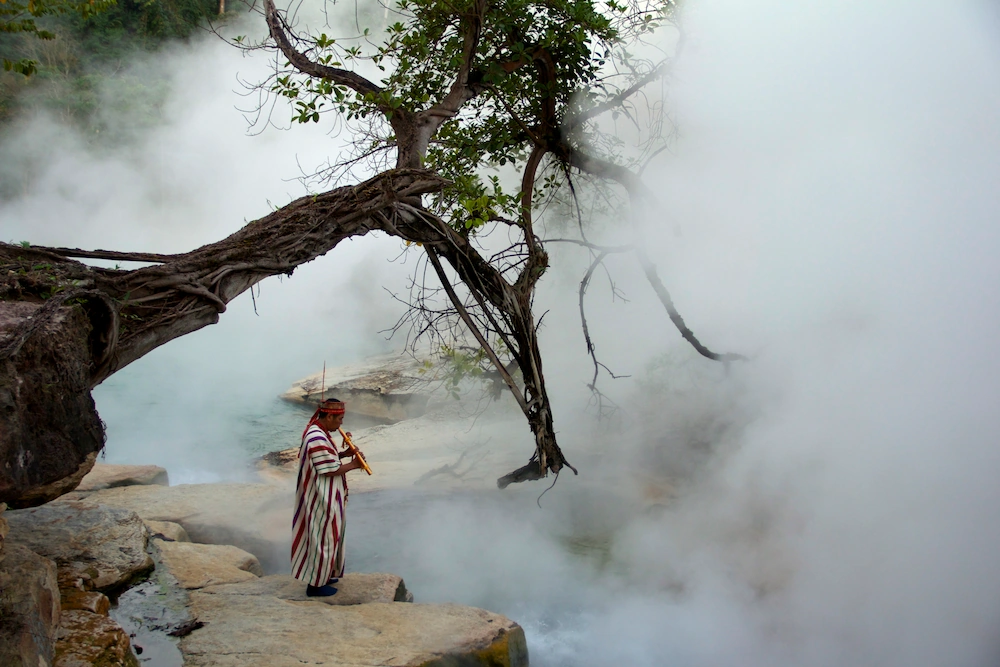
In the central-eastern Peruvian Amazon, a unique river known as Shanay-Timpishka, or "the boiling river," exhibits water temperatures that can reach nearly 100°C, with measurements as high as 86°C and even 99.1°C recorded. This extreme heat prevents any aquatic life, such as fish, toads, or snakes, from surviving near its waters. Geologists have been puzzled by this phenomenon because the nearest volcanic activity is approximately 700 kilometers away, unlike other known hot rivers globally, such as those in Beppu, Japan, Yellowstone, USA, or Iceland. These other geothermal rivers are typically situated near volcanoes or magma sources, and their heat is localized and directly linked to magma. The Shanay-Timpishka, however, heats a stretch of about 4 kilometers without any apparent volcanic influence. Researchers have determined that the river's heat originates from normal geothermal activity within the Earth's crust. Rainwater seeps through a complex network of faults to significant depths, where it is heated by the geothermal gradient—the natural increase in temperature with depth. The heated water then ascends through the same fault system, feeding the river. The remarkable aspect is this mechanism's capacity to maintain a substantial flow and high temperatures over an extended distance. However, several mysteries persist regarding the depth and geometry of the faults, the duration of the water's cycle, and the precise reason for this phenomenon occurring specifically in this location. The river's age and the origin and volume of its water supply also remain unknown.
The Shanay-Timpishka river presents a fascinating case of geothermal activity divorced from typical volcanic indicators. While researchers attribute the heat to deep crustal water circulation, the persistence of such high temperatures over a 4km stretch, without clear geological mapping of the fault system's depth, geometry, or recharge dynamics, highlights the limits of current understanding in complex geological environments. This natural anomaly underscores the Earth's diverse thermal processes, which may operate independently of surface volcanism. Future research could leverage advanced geophysical imaging and hydrological modeling to elucidate the specific subsurface architecture and water-rock interactions driving this sustained thermal output, offering insights into geothermal energy potential and the Earth's internal heat distribution mechanisms beyond conventional magma-driven systems.
AI-generated to prompt reflection — not editorial opinion, not advice, not a statement of fact. How this works.