Physicists Create Liquid-Based Computing Hardware from Chaotic Particle Orbits
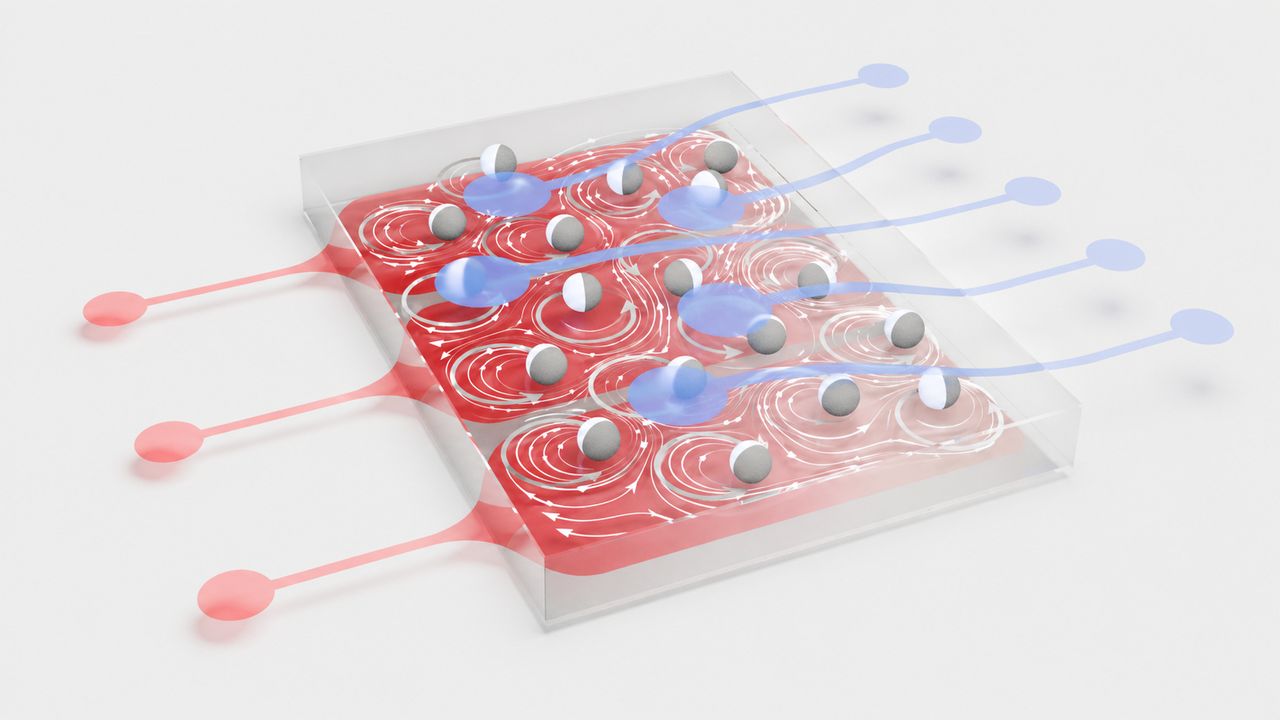
Researchers have developed a novel form of computing hardware utilizing particles in chaotic orbits, described as a "liquid computer." These oscillators are composed of 3μm radius silica spheres, each coated on one side with an 80nm layer of carbon. The spheres are suspended in a specific liquid mixture of water and lutidine, maintained at a constant temperature of 28°C. While this fluid hardware represents an innovative approach to computation, it currently lags behind competing technologies such as memristors in performance. The system leverages the complex, unpredictable motion of these particles to perform computational tasks. This breakthrough opens new avenues for exploring alternative computing paradigms beyond traditional silicon-based architectures. The use of a liquid medium and precisely engineered particles suggests a potential for self-assembly and adaptability in future hardware designs. However, the practical application and scalability of this liquid computing approach will depend on overcoming current performance limitations compared to established technologies.
This development in liquid computing, using chaotic particle dynamics, presents an intriguing alternative to conventional hardware. The system's reliance on fluid mechanics and self-organizing principles contrasts sharply with the rigid, lithographically defined structures of silicon chips. While the current performance gap with memristors highlights the engineering challenges ahead, the potential for novel computational substrates is significant. Future advancements may focus on optimizing particle interactions, fluid dynamics, and interface mechanisms to enhance processing capabilities. The long-term implications could involve exploring bio-inspired computing or adaptive, reconfigurable hardware, though market adoption will hinge on demonstrating clear advantages in energy efficiency, cost, or unique computational functions beyond current benchmarks.
AI-generated to prompt reflection — not editorial opinion, not advice, not a statement of fact. How this works.