Physicists Explore Van Gogh's 'The Starry Night' for Turbulence Insights
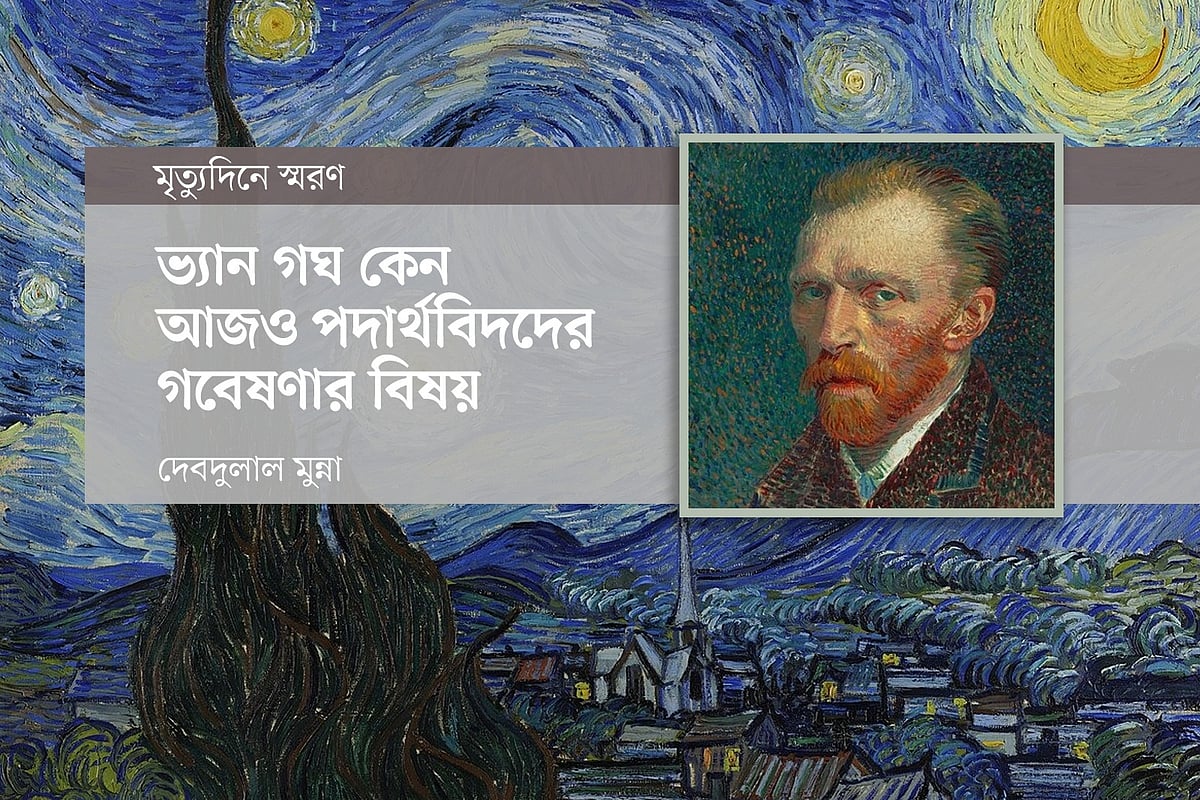
Physicists are increasingly drawn to the works of Vincent van Gogh, particularly his painting 'The Starry Night,' attempting to understand his art through the lens of physics. Despite extensive analysis, a definitive conclusion remains elusive, with some suggesting Van Gogh possessed a scientific, albeit 'mad scientist,' intuition. The painting's depiction of swirling stars and celestial motion has been linked to mathematical models of turbulence, a chaotic phenomenon in fluid dynamics. Physicists are examining Van Gogh's brushstrokes and color choices, finding them to align remarkably with concepts of 'hidden turbulence' in atmospheric gases. Russian scientist Andrei Kolmogorov's theory, which describes the distribution of eddies from large to small in a specific ratio, appears to be mirrored in 'The Starry Night,' a work created 52 years before Kolmogorov's theory was formulated. This suggests Van Gogh intuitively captured complex physical principles. Researchers, including a team from the National Autonomous University of Mexico, have noted that the natural uncertainty and dynamic motion depicted in Van Gogh's art closely follow mathematical structures. While Van Gogh never formally studied physics, his profound observational skills allowed him to render natural patterns with astonishing accuracy. His ability to visually represent the chaotic flow of motion and energy transfer, as described in turbulence theory, has led some to believe he possessed an innate understanding of these phenomena. This intuitive grasp of complex scientific concepts, evident in works like 'The Starry Night' and 'Sunflowers,' continues to fascinate scientists, prompting further investigation into the intersection of art, intuition, and scientific principles.
The analysis of Vincent van Gogh's 'The Starry Night' by physicists highlights a fascinating intersection of artistic intuition and scientific principles. It suggests that complex natural phenomena like turbulence, which remain challenging for modern physics, were intuitively understood and visually represented by an artist over a century ago. This phenomenon prompts reflection on the nature of human perception and the potential for non-traditional pathways to scientific insight. The situation raises questions about whether formal scientific education is the sole route to understanding the universe's mechanics, or if profound observation and artistic expression can also unlock fundamental truths. Furthermore, it invites consideration of how AI and advanced computational tools might be used to further explore these connections, potentially revealing deeper patterns in both art and science and offering new perspectives on human creativity and understanding in the coming decades.
AI-generated to prompt reflection — not editorial opinion, not advice, not a statement of fact. How this works.