PM Aims for Trillion-Dollar Economy by 2034, Invites Investment
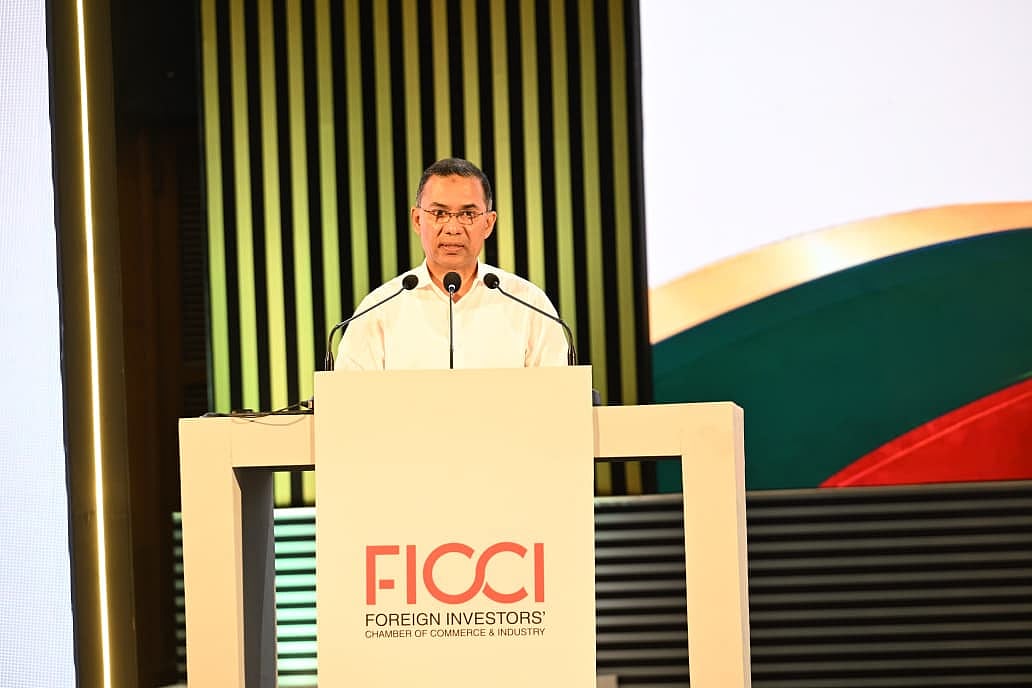
Prime Minister Tareq Rahman announced the government's commitment to transforming Bangladesh into a trillion-dollar economy by 2034. He extended an invitation to both domestic and international entrepreneurs and investors to establish new ventures and expand their businesses within the country. The Prime Minister made these remarks at the FICCI Investment Conference, themed 'Accelerating Foreign Investment for Employment and Prosperity in Bangladesh,' organized by the Foreign Investors Chamber of Commerce and Industry (FICCI). The conference took place on Thursday at the Bangladesh-China Friendship Exhibition Center (BCFEC) in Dhaka. The Prime Minister highlighted that the budget includes specific incentives for priority sectors such as renewable energy, pharmaceuticals, electronics, digital services, agro-processing, advanced textiles, healthcare, and logistics. He emphasized Bangladesh's ambition to become a major global manufacturing hub, diversifying the ready-made garment industry and prioritizing technological advancement and skill development for human capital. The government pledges institutional support and timely policy adjustments for all investors, assuring them of its concrete commitment. Despite facing challenges, Bangladesh possesses significant potential, including a rapidly growing domestic market, a young and diligent workforce, a strategic geographic location, and a democratically elected government with strong public support, all contributing to sustainable prosperity. The government aims to build a rules-based, globally integrated economy driven by private sector dynamism, with its electoral manifesto outlining a clear roadmap for this economic transformation. Having completed five months in office, the new administration has been preparing its economic and policy frameworks for a considerable period, actively listening to stakeholders. Reforms are underway to modernize legal and regulatory structures, enhance investor protection, expedite dispute resolution, simplify tax and VAT administration, and streamline profit repatriation. The government is also focused on developing a dynamic capital market, encouraging startups, removing unnecessary regulations, simplifying administrative processes, and digitizing public services, alongside increased investment in renewable energy, port infrastructure, logistics, and energy security.
The government's ambitious target of a trillion-dollar economy by 2034, coupled with a strong invitation for foreign direct investment, signals a strategic shift towards economic liberalization and global integration. The emphasis on specific growth sectors and policy reforms aims to create a more attractive investment climate. However, the success of these initiatives will depend on the consistent implementation of regulatory modernization, efficient dispute resolution mechanisms, and the effective digitization of public services. International investors will likely assess the long-term stability of these policies and the government's capacity to navigate potential economic headwinds and geopolitical shifts. The focus on human capital development and renewable energy aligns with global trends, suggesting a forward-looking approach to sustainable development, but the actualization of these plans will require substantial and sustained capital infusion and effective governance.
AI-generated to prompt reflection — not editorial opinion, not advice, not a statement of fact. How this works.