PM Urges 'Green Settlements,' Emphasizes Tree Planting and Environmental Conservation
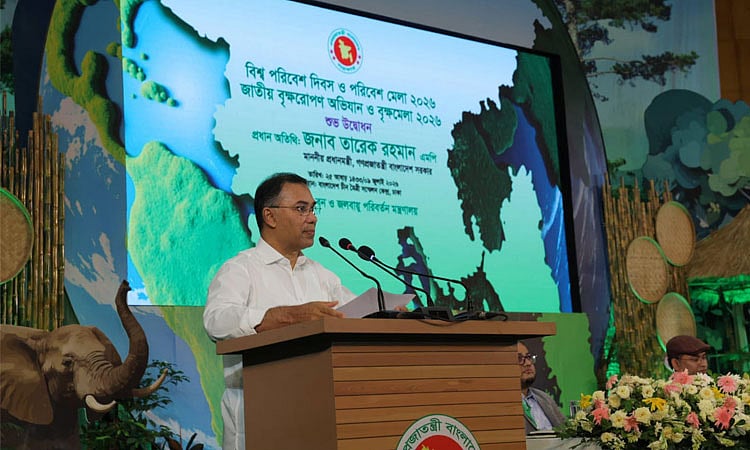
Prime Minister Tareq Rahman has called for collective effort to transform Bangladesh into a 'green settlement,' urging citizens to integrate tree planting and environmental conservation into their daily routines. He stated that collaborative action is essential for building a verdant, healthy, and secure living environment. The Prime Minister made these remarks on Thursday while inaugurating the World Environment Day, Environment Fair, and the National Tree Plantation Campaign and Tree Fair-2026. He highlighted the fair as a vital investment for the well-being of current and future generations, emphasizing that it should transcend mere annual formality. The Prime Minister stressed the importance of making Bangladesh a safe haven for all living beings. The event, organized by the Ministry of Environment, Forest, and Climate Change, took place at the Bangladesh-China Friendship Conference Center. This year's theme for the National Tree Plantation Campaign and Tree Fair is 'Decorate the Country with Tree Planting, Bangladesh First.' During the ceremony, the Prime Minister presented the National Tree Plantation Award-2025 and the National Wildlife Conservation Award-2026, and distributed profit-sharing checks to forestry stakeholders. He encouraged everyone to plant a tree, reflecting on how Dhaka's greenery has diminished since his childhood and advocating for a new approach, such as planting a tree to commemorate the birth of a child. The Prime Minister also highlighted government initiatives, including the establishment of Green Volunteering in educational institutions, the planting of approximately 90,000 trees in schools, the launch of the Climate Youth Fellowship, and the Environment Start-up Fund, all aimed at creating a safer, healthier, and greener Bangladesh. He reiterated the government's manifesto commitment to planting 250 million new trees over five years, stressing the need for strategic planting based on environmental suitability, soil type, and climate, prioritizing native species like medicinal plants, orchids, bamboo, fruit-bearing trees, economically valuable trees, and endangered species, while avoiding environmentally harmful ones. The Prime Minister also called for the protection of existing ecosystems, particularly 'mother trees,' and urged strict measures against deforestation, hill cutting, mangrove destruction, and wildlife poaching, acknowledging the difficulty of changing long-standing mindsets. He emphasized the critical need to save rivers for agricultural, food, and water security, advocating for development in harmony with nature. The government plans to develop rooftop gardens, urban forestry, GIS-based tree planting, greening riverbanks and canals, and eco-tourism as new economic sectors. Recognizing the daily challenges posed by cyclones, floods, droughts, heatwaves, river erosion, and salinity, the government views environmental protection not as a separate sector but as a fundamental pillar of national development, aiming for a green, clean, climate-resilient, and sustainable Bangladesh. The Prime Minister also highlighted the importance of dredging and re-excavating 20,000 kilometers of rivers and canals to ensure irrigation and combat climate change impacts, while also stressing the urgent need for radical changes in waste management across all urban areas. He urged citizens to avoid littering, reduce plastic waste, and promote composting, recycling, waste-to-energy production, and the 'Reduce, Reuse, Recycle' (3R) principles. Finally, he appealed for collective responsibility in protecting biodiversity, which is threatened by population growth, climate change, unplanned urbanization, and habitat destruction, emphasizing the need to save wildlife and aquatic life by all means possible.
The Prime Minister's address underscores a critical juncture for Bangladesh, where development imperatives increasingly intersect with environmental sustainability. The emphasis on 'green settlements' and ambitious tree-planting targets reflects a growing awareness of climate vulnerability and the need for ecological resilience. However, the success of these initiatives hinges on systemic implementation beyond ceremonial events. The call for strategic species selection and the protection of 'mother trees' indicates a nuanced understanding of ecological principles, moving beyond simple reforestation. The challenge lies in aligning these aspirations with the powerful economic and developmental pressures that often drive habitat destruction and resource depletion. Future policy must address the underlying incentive structures that favor short-term economic gains over long-term ecological health, ensuring that environmental conservation is integrated into all facets of national planning, not treated as a supplementary measure. The government's recognition of environmental challenges as fundamental to national development, rather than a separate sector, is a positive step, but translating this vision into tangible, enforceable actions will be key to building a truly sustainable and climate-resilient Bangladesh over the next decade.
AI-generated to prompt reflection — not editorial opinion, not advice, not a statement of fact. How this works.