Police Officer Demonstrates Hidden Compartment for Drugs in Car Panel
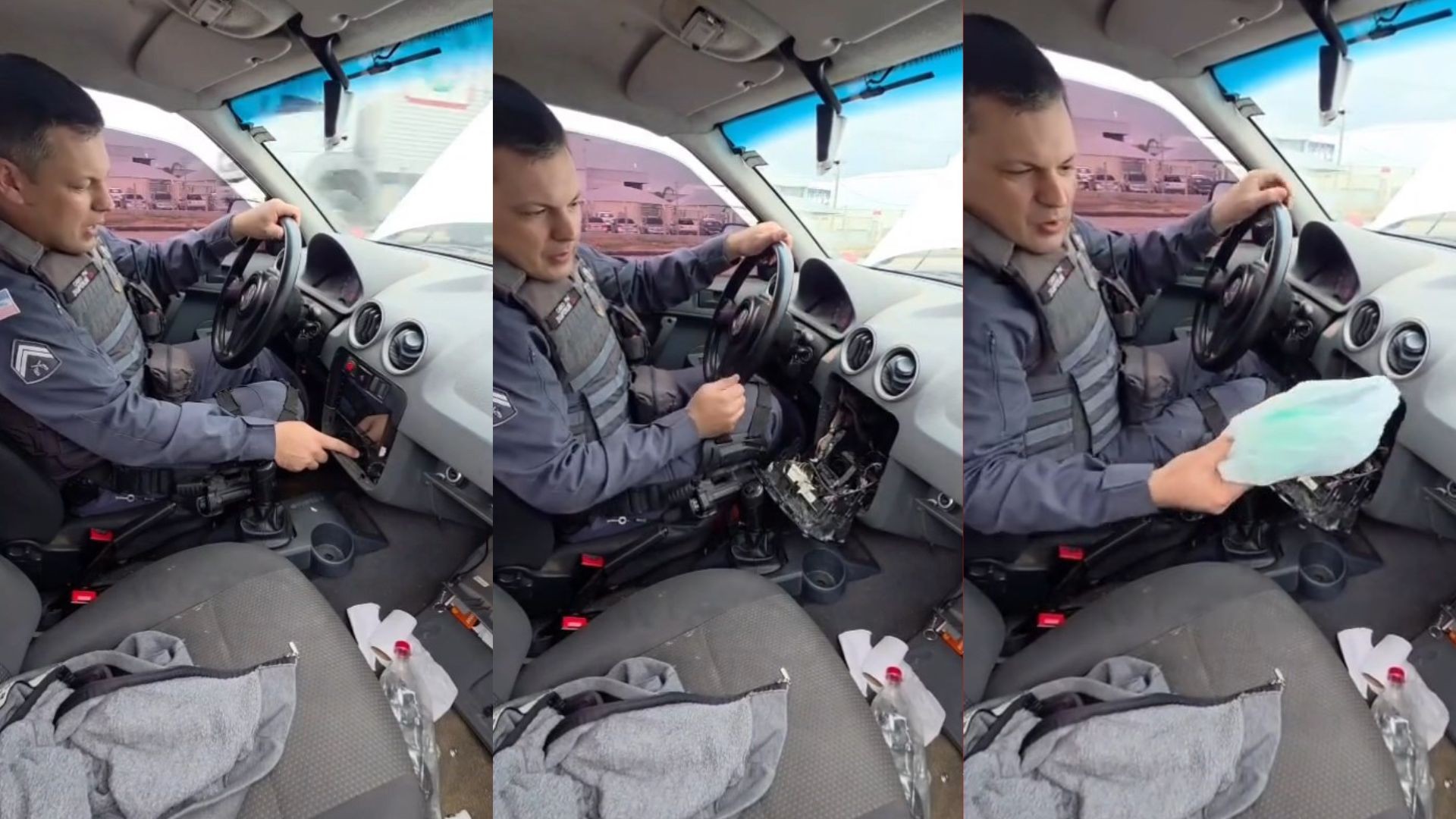
A viral video shows a police officer in Aracruz, Espírito Santo, Brazil, demonstrating how to access a secret compartment within a car's dashboard designed to conceal drugs. The footage captured during a traffic stop on Wednesday, October 2nd, features the officer calling the demonstration a 'tutorial' for his colleagues. The suspect, identified as 40-year-old Rodrigo Lopes Soares, was apprehended after confessing to transporting drugs and showing the police how to open the hidden panel. The compartment, located behind the car's sound system, revealed approximately half a kilogram of cocaine base paste. Soares stated he was to be paid R$1,000 for the transport. He was taken to the Aracruz Regional Police Station, charged with drug trafficking, and subsequently sent to prison. This incident marks his first entry into the Espírito Santo prison system. The vehicle was impounded. The apprehension followed intelligence received by the 5th BPM indicating drug transport in the vehicle, with officers observing the driver discard an object during the pursuit. Despite an initial search yielding no illicit materials, Soares' confession led to the discovery of the drugs. A public safety researcher noted that criminal organizations continuously innovate their methods to evade law enforcement, emphasizing the need for ongoing police intelligence, investigation, and technological advancements to counter evolving concealment strategies.
This event highlights the persistent cat-and-mouse dynamic between law enforcement and criminal organizations, where innovation in concealment methods is a direct response to evolving interdiction techniques. The criminal element's adaptation, as demonstrated by the sophisticated hidden compartment, underscores the necessity for continuous investment in advanced detection technologies and human intelligence gathering by police forces. The researcher's commentary points to a broader systemic challenge: as contraband routes and methods shift, so too must the strategies and training of those tasked with intercepting them. The future of law enforcement effectiveness in combating organized crime will likely hinge on predictive analytics and proactive intelligence, rather than solely reactive measures, to anticipate and neutralize these evolving criminal tactics.
AI-generated to prompt reflection — not editorial opinion, not advice, not a statement of fact. How this works.