Potentially Habitable Super-Earth Discovered 25 Light-Years From Earth
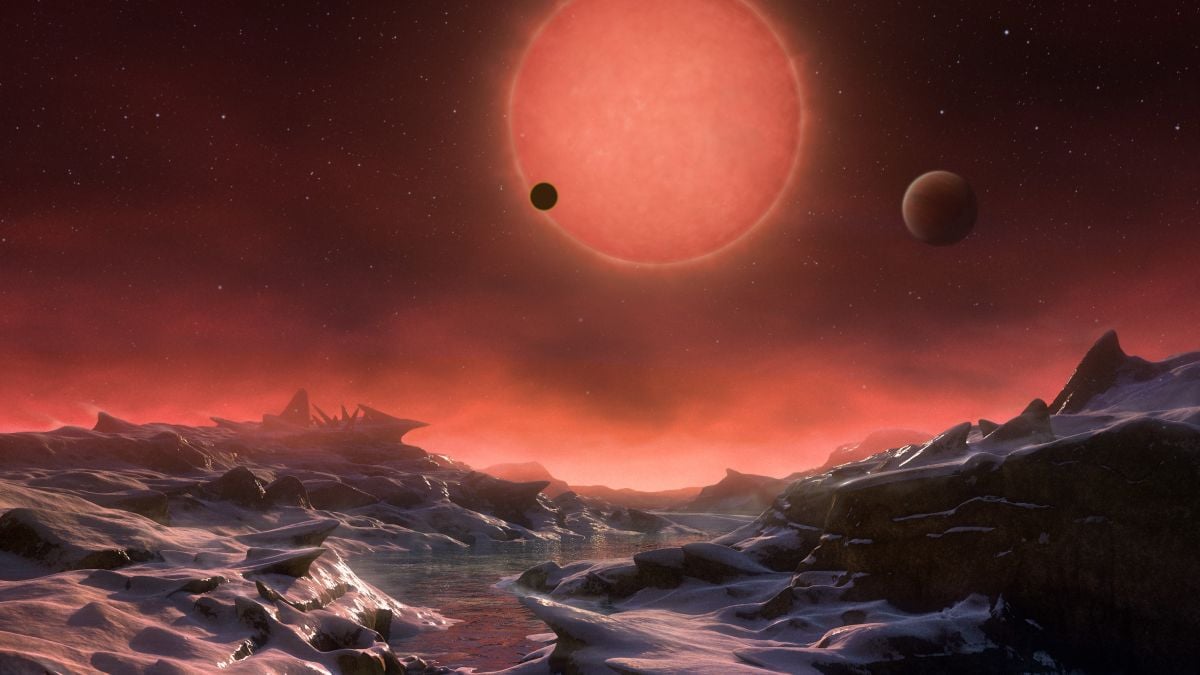
Astronomers have identified a super-Earth exoplanet, designated Wolf 1069 b, located a mere 25 light-years away from our solar system. This newly found planet orbits a red dwarf star and resides within its star's habitable zone, suggesting the potential for liquid water on its surface. Wolf 1069 b has a mass approximately 1.26 times that of Earth and is expected to have a rocky composition. Its orbital period is about 15.6 days. The planet is tidally locked, meaning one side perpetually faces its star, while the other remains in darkness. This tidal locking could create extreme temperature differences, but the star's relatively low radiation output might allow for a stable atmosphere and liquid water in the twilight zone between the hot and cold hemispheres. The discovery was made using the CARMENES instrument at the Calar Alto Observatory in Spain. Scientists are hopeful that future observations with advanced telescopes, such as the James Webb Space Telescope, could provide more detailed information about its atmosphere and potential habitability. The proximity of Wolf 1069 b makes it a prime candidate for further study in the search for extraterrestrial life.
The discovery of Wolf 1069 b, a super-Earth within its star's habitable zone, highlights the ongoing progress in exoplanet detection and characterization. Its proximity of 25 light-years makes it a compelling target for follow-up studies, potentially offering insights into planetary formation and the conditions necessary for habitability beyond our solar system. The tidal locking presents a significant environmental factor, creating distinct thermal gradients that could influence atmospheric dynamics and the distribution of potential biosignatures. Future investigations will be crucial in determining whether the atmospheric conditions can mitigate these extremes and support liquid water, a key ingredient for life as we know it. This finding underscores the growing likelihood of identifying Earth-like planets within our galactic neighborhood, prompting further refinement of astrobiological search strategies.
AI-generated to prompt reflection — not editorial opinion, not advice, not a statement of fact. How this works.