Presidential Delay in Judicial Appointments Disrupts Court Operations
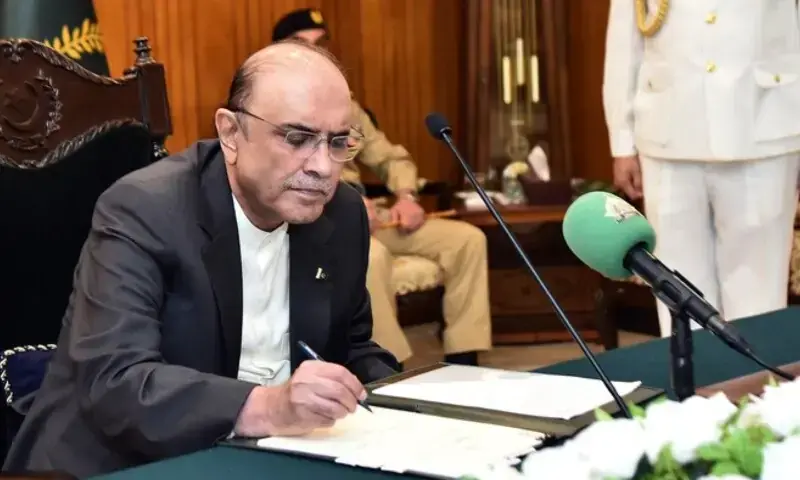
The Pakistani judiciary is facing operational disruptions due to delays in presidential assent for judicial appointments. The term of an additional judge at the Sindh High Court (SHC), Justice Khalid Hussain Shahani, has already expired on July 29, despite the Judicial Commission of Pakistan (JCP) recommending a six-month extension. Justice Shahani was initially appointed for a one-year term on January 29, 2025, and his tenure was previously extended by six months until July 29 by President Asif Ali Zardari. The JCP recommended a further extension on July 20, but the summary remains pending with the Presidency. Sources in the Presidency indicate that an additional judge cannot continue in office without formal presidential approval and a Law Ministry notification. A similar situation is unfolding at the Peshawar High Court (PHC), where the terms of four additional judges—Justice Farah Jamshed, Justice Inamullah Khan, Justice Sabitullah Khan, and Justice Aurangzeb—are set to expire on August 4. These judges were appointed on February 4, 2025, and after an initial six-month extension approved by the president, the JCP has again recommended further extensions, which are now awaiting presidential assent. This uncertainty follows similar delays in the assent for additional judges to the Islamabad, Lahore, Sindh, and Balochistan high courts, raising concerns among legal professionals. The Pakistan Bar Council and the Supreme Court Bar Association have emphasized that judges cannot perform judicial functions after their tenure expires without official notification, and that the president cannot indefinitely withhold assent to constitutionally recommended appointments.
The prolonged delay in presidential assent for judicial appointments, as observed in Pakistan, highlights a potential systemic friction between the executive and judicial branches. While the constitution outlines a process for judicial appointments, the executive's discretion in granting final approval, even after recommendations from the Judicial Commission of Pakistan, introduces an element of uncertainty. This can lead to a 'lame duck' period for judges whose terms are expiring, potentially impacting judicial continuity and efficiency. The situation raises questions about the balance of power and the predictability of judicial staffing, which are crucial for public trust and the rule of law. Future governance models might explore mechanisms to streamline this process, ensuring that judicial independence is not compromised by administrative delays, thereby safeguarding the consistent functioning of the judiciary.
AI-generated to prompt reflection — not editorial opinion, not advice, not a statement of fact. How this works.