Prime Minister Shehbaz Sharif Arrives in Turkiye for Official Visit
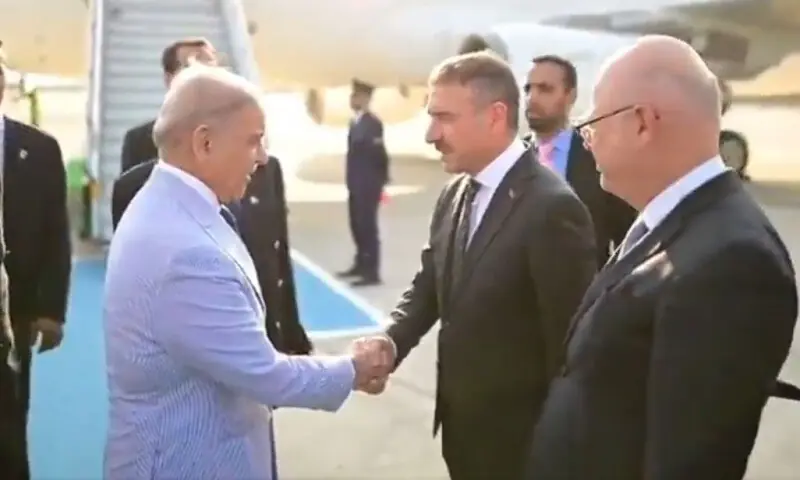
Prime Minister Shehbaz Sharif arrived in Istanbul, Turkiye on Friday for an official visit, extending from an invitation by President Recep Tayyip Erdogan. The visit follows Prime Minister Sharif's attendance at the funeral of Iranian Supreme Leader Ayatollah Ali Khamenei, who was reportedly assassinated on February 28. Upon arrival at Istanbul's Ataturk Airport, the Prime Minister was greeted by Turkish Minister of Trade Professor Dr. Omer Bolat, Pakistan's Ambassador to Turkiye Dr. Yusuf Junaid, and other officials. Accompanying the Prime Minister are Deputy Prime Minister and Foreign Minister Senator Ishaq Dar and Minister for Information and Broadcasting Attaullah Tarar. The agenda includes extensive discussions between Prime Minister Sharif and President Erdogan on bilateral relations, with a specific emphasis on boosting trade and investment cooperation. Regional peace and security will also be key topics of discussion. Additionally, Prime Minister Sharif is slated to address a Pakistan-hosted business conference in Istanbul, designed to showcase investment prospects in areas such as special economic zones, energy, information technology, and privatization. This conference is expected to draw significant Turkish business leaders, investors, and government officials. The visit occurs amidst strong Pakistan-Turkiye ties, recently reinforced by three Memoranda of Understanding (MoUs) signed last week to enhance collaboration in the power sector between entities like Pakistan's ISMO and PPMC, and Turkiye's EPIAS, TEIAS, and TEDAS.
This visit underscores the strategic importance of bilateral relations between Pakistan and Turkiye, particularly in economic cooperation. The timing, following a significant geopolitical event involving Iran, suggests potential discussions on regional stability and security dynamics. The focus on trade, investment, and energy sector MoUs highlights a deliberate effort to leverage existing strong ties for tangible economic development. Future engagement will likely be shaped by evolving regional security landscapes and the ability of both nations to translate these agreements into concrete economic outcomes, especially within the context of global economic shifts and technological advancements impacting trade and energy sectors.
AI-generated to prompt reflection — not editorial opinion, not advice, not a statement of fact. How this works.