Protesters in Delhi Mask Faces Amidst AI-Powered Police Surveillance
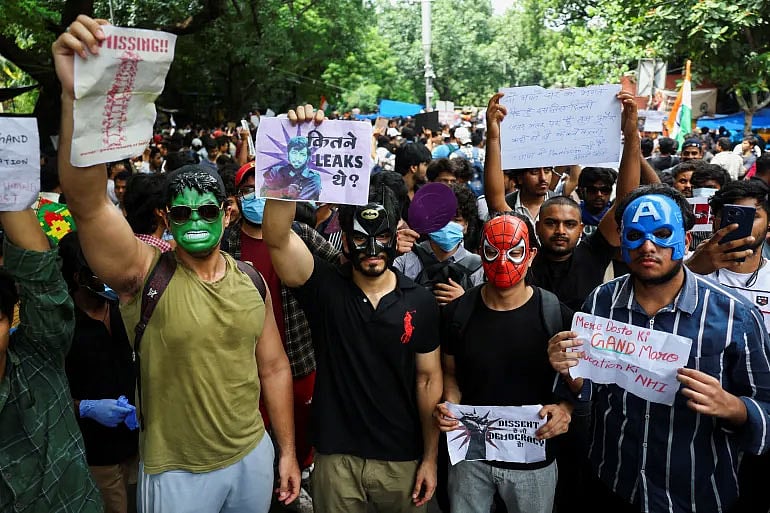
Delhi Police have deployed advanced surveillance vehicles, including a "Mobile Command and Control Vehicle" and an AI-powered "Ikshan" van, near Jantar Mantar, the site of ongoing student protests. The Ikshan van, equipped with facial recognition software, analyzes video footage from CCTV cameras, comparing faces against a database of criminals. This technology, integrated before the 2023 G20 Summit, aims to identify known offenders, according to a senior police official who remained anonymous. However, students participating in the protests report that this constant surveillance is creating fear and intimidation. Consequently, many are covering their faces during demonstrations to avoid potential future repercussions, especially those preparing for competitive government job exams who fear their identities being recorded. Some students are also concerned about their parents discovering their participation, as they are not aware of their children being at the protests. A Delhi Police official acknowledged that there is no specific data retention policy for the recorded videos, stating they are kept for potential investigations that could arise months later, even after protests conclude. The intrusive surveillance has led to a petition filed in the Delhi High Court by Aishwarya Ghosh, former president of the Jawaharlal Nehru University Students' Union, alleging continuous, indiscriminate, and unauthorized monitoring that infringes upon protesters' rights to privacy, dignity, free speech, and peaceful assembly. The court has sought a response from the government regarding this matter. While authorities claim these technologies enhance public safety and police efficiency, civil rights advocates express serious concerns about privacy, necessity, transparency, and the lack of a comprehensive legal framework governing their use. The Digital Personal Data Protection Act, 2023, provides significant exemptions for security forces and government agencies, limiting protections for citizens.
AI-powered facial recognition technology, deployed by law enforcement during public demonstrations, presents a complex interplay between public safety objectives and fundamental civil liberties. While the stated intent is to identify individuals with criminal records and maintain order, the pervasive nature of such surveillance can create a chilling effect on freedom of expression and assembly. The technology's accuracy and the potential for misidentification, coupled with broad governmental exemptions in data protection laws, raise questions about proportionality and due process. As digital surveillance capabilities advance, societal norms and legal frameworks must evolve to ensure that the pursuit of security does not inadvertently erode the democratic principles of privacy and dissent, particularly in an era where digital footprints are increasingly permanent and accessible.
AI-generated to prompt reflection — not editorial opinion, not advice, not a statement of fact. How this works.