PUC-Rio Establishes First Perpetual Scholarship with R$2.5 Million Donation
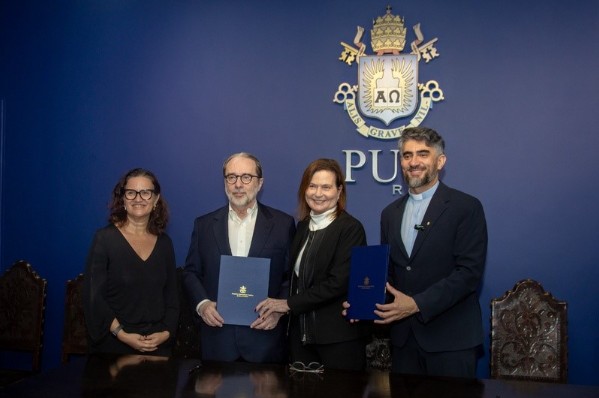
Pontifical Catholic University of Rio de Janeiro (PUC-Rio) has officially established its first perpetual scholarship, made possible by a R$2.5 million donation from alumni Belkiss Ferraz de Castro and Carlos Infante de Castro. This significant contribution will be allocated to the university's Endowment Fund, ensuring its impact for generations to come. Unlike traditional scholarships, the principal amount of the donation will remain invested, with only the financial returns funding student education continuously. The ceremony marking the donation was attended by PUC-Rio's Rector, Father Anderson Antonio Pedroso, and the President of Alumni PUC-Rio, Barbara Cristhian, alongside the donors and other guests. The first student to benefit from this perpetual scholarship is expected to enroll in 2027, with the fund supporting low-income students admitted to Science, Technology, Engineering, and Mathematics (STEM) programs. Beyond tuition fees, the scholarship will cover living expenses such as food, transportation, and, when necessary, housing. Rector Pedroso highlighted the donation as a transformative act of solidarity, while Barbara Cristhian expressed hope that this initiative will inspire further contributions to enhance access to higher education. The PUC-Rio Endowment Fund, relaunched in 2024, currently holds approximately R$7 million and aims to reach R$35 million by 2028, with the Alumni network having already mobilized over R$30 million since 2019 for various university projects. This model of endowment funds, supported by Brazilian Law nº 13.800/2019 and inspired by international universities, ensures long-term financial support for academic endeavors.
This endowment establishes a novel financial mechanism for sustained educational access at PUC-Rio, moving beyond immediate funding cycles. By preserving the principal and utilizing investment yields, the university aims for enduring support, particularly for STEM fields and low-income students. This approach reflects a growing trend in higher education globally, seeking to build long-term financial resilience through diversified funding streams. The success of this model hinges on consistent investment performance and the university's ability to attract further contributions to scale its impact. Future challenges may include navigating market volatility and ensuring equitable distribution of resources to meet evolving student needs within a dynamic academic landscape.
AI-generated to prompt reflection — not editorial opinion, not advice, not a statement of fact. How this works.